Data Structures in Java: From Linked Lists to an Unbeatable Tic-Tac-Toe AI
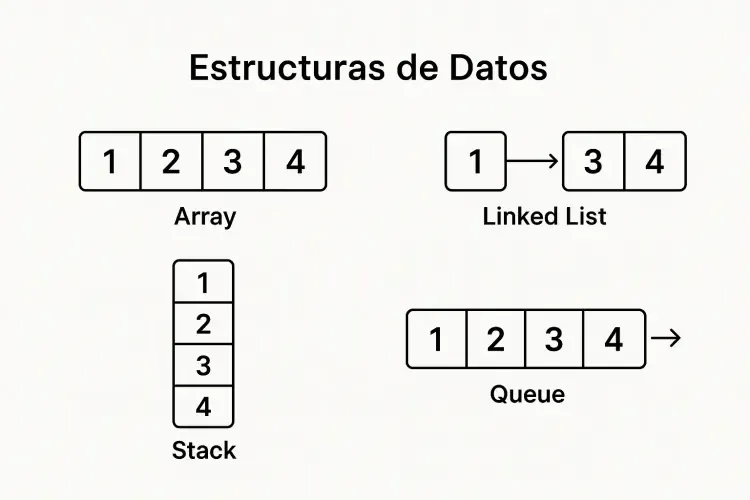
If Programming 1 with DrScheme taught me to think, Programming 2 with C taught me what the machine was actually doing, and OOP taught me to design well-architected systems — then Data Structures was the course where all of that converged into a single question: how do you organize your data so your program is efficient?
Data Structures. The course that separates people who can write code from people who can write efficient code. The course that makes you realize a simple list isn’t always the answer, that how you store your data changes everything about how fast you can find it, sort it, or traverse it.
From design patterns to algorithmic patterns
I was coming from a semester where the focus was architecture: MVC, Observer, separation of concerns, designing before coding. In OOP I’d built a full Sudoku solver with Java Swing — with constraint propagation via the Observer pattern, backtracking with state cloning, and a GUI with undo/redo. I already knew Java. I already knew how to think in classes, encapsulation, inheritance, interfaces.
But Data Structures changed the question. In OOP, the question was: how do I structure my code so it’s maintainable? Here the question was: how do I structure my data so operations are fast? It was no longer enough for the program to be well-organized — it had to be efficient.
And the OOP foundation helped more than I expected. Knowing how to think in classes meant that implementing a NodoLista with encapsulation and getters/setters was natural. Understanding interfaces meant I could design structures with clear contracts. The discipline of separating concerns that I’d practiced with MVC translated directly into clean implementations of each structure.
public class NodoLista {
    private Object dato;
    private NodoLista siguiente;

    public NodoLista(Object dato) {
        this.dato = dato;
        this.siguiente = null;
    }
}
What surprised me was that the recursive thinking I’d trained in Scheme transferred perfectly to this new context too. Trees are recursive. Graphs are recursive. Most of the elegant solutions in data structures are recursive. Scheme had prepared me for the algorithms, and OOP had prepared me for the implementation. Data Structures brought both worlds together.
The building blocks: stacks and queues
Every data structures course starts at the same place: linked lists. And from linked lists, you build everything else.
A linked list is deceptively simple — each node holds a piece of data and a pointer to the next node. That’s it. But from that simple idea, you get two fundamental structures:
Stacks — Last In, First Out. Think of a stack of plates. You can only add to the top and remove from the top. We implemented push(), pop(), and peek(), and suddenly you understand how your browser’s back button works, how undo/redo works, how function call stacks work. The concept that had been abstract in Scheme — the call stack growing and unwinding during recursion — now had a concrete implementation I could touch. And the most satisfying part: I had already used stacks without knowing I was using them — the undo/redo in the Sudoku solver from OOP was literally two Stack<Model> objects. Now I was building the structure that made it possible, from scratch.
Queues — First In, First Out. A line at the supermarket. The first person in line is the first person served. We implemented enqueue(), dequeue(), and I remember the satisfaction of building the queue on top of the same linked list class we’d already written for stacks. Same foundation, different rules, completely different behavior.
public void enqueue(Object dato) {
    NodoLista nuevoNodo = new NodoLista(dato);
    if (isEmpty()) {
        cabeza.setSiguiente(nuevoNodo);
    } else {
        NodoLista actual = cabeza.getSiguiente();
        while (actual.getSiguiente() != null) {
            actual = actual.getSiguiente();
        }
        actual.setSiguiente(nuevoNodo);
    }
}
Simple? Yes. But building these from scratch — not using java.util.Stack or java.util.Queue, but implementing every pointer manipulation yourself — that’s where the real learning happens. In OOP we’d used LinkedList from the standard library for the contact agenda without a second thought. Now I understood exactly what was happening inside that class.
Trees: where things get interesting
If stacks and queues are the appetizers, binary trees are where the main course begins.
A binary tree is a node with at most two children: left and right. Simple definition, infinite complexity. Our implementation covered everything:
-
Traversals — preorder, inorder, postorder, level-order. Four different ways to visit every node, each useful for different purposes. I remember the moment when I understood that inorder traversal of a binary search tree gives you sorted output — it felt like discovering a secret.
-
Syntax tree evaluation — this was the project that connected several semesters. We built a tree that could represent mathematical expressions like
((5 + 3) * 2)as a tree structure, then evaluate them by traversing bottom-up. The same concept I’d implemented in Scheme with prefix notation, now implemented in Java with objects and pointers — and with the encapsulation discipline I’d learned in OOP. -
AVL balance verification — checking whether a tree satisfies the balance property. Not implementing full AVL rotations (that would come later), but understanding why balance matters and how to detect imbalance.
-
Tree comparison — algorithms to check if two trees are identical, if one is a subtree of another. Elegant recursive solutions that made me appreciate how naturally trees map to recursive thinking.
Then came N-ary trees — trees where each node can have any number of children, not just two. We implemented them using a parent-sibling-child pointer structure and built algorithms for:
- Isomorphism checking — are two trees structurally identical, regardless of the data they contain?
- Lowest common ancestor — given two nodes, find their closest shared parent
- Stability verification — checking whether parent values are always greater than their children
Each algorithm was an exercise in thinking recursively about hierarchical data. And each one reinforced something I’d learned in Scheme: if you can solve it for one level, recursion handles the rest.
Graphs and the beauty of Dijkstra
Then came graphs, and with them, a whole new way of modeling the world.
A graph is nodes connected by edges. Roads between cities. Friendships in a social network. Dependencies between software packages. We implemented directed weighted graphs using adjacency lists — each vertex maintains a list of its outgoing edges, each edge carries a cost.
public class Grafo {
    private ListaVertice listaVertices;

    public void insertarVertice(Object dato) { ... }
    public void insertarArco(Object origen, Object destino, int costo) { ... }
    public boolean existeCamino(Object origen, Object destino) { ... }
}
But the real star of the graph module was Dijkstra’s shortest path algorithm. The idea is elegant: starting from a source node, progressively explore the cheapest unexplored path until you’ve found the shortest route to every reachable node.
I remember implementing it step by step — the distance table, the visited set, the greedy selection of the minimum-cost unvisited vertex — and running it for the first time on a small graph. Watching the algorithm find paths I hadn’t seen myself. That was the first time I felt like I’d built something genuinely smart. Not just code that followed instructions, but code that discovered answers.
The crown jewel: an unbeatable Tic-Tac-Toe
For the final project, we built something that brought every data structure together: a Tic-Tac-Toe game with an AI opponent that never loses.
The secret? The Minimax algorithm — a decision-making algorithm from game theory that considers every possible future state of the game and chooses the optimal move.
Here’s how it works: the program builds an N-ary game tree where each node is a board state and each child is a possible next move. From any position, the algorithm recursively evaluates all possible continuations:
- If the computer wins → score +9
- If it’s a draw → score 0
- If the player wins → score -9
The computer picks the move that leads to the highest guaranteed score. The player, being the adversary, is assumed to pick the move that leads to the lowest score. Max and min, alternating — hence, “Minimax.”
// Win detection - 8 possible winning combinations
// 3 rows, 3 columns, 2 diagonals
if ((tablero[0] == jugador && tablero[1] == jugador && tablero[2] == jugador) ||
    (tablero[3] == jugador && tablero[4] == jugador && tablero[5] == jugador) ||
    (tablero[6] == jugador && tablero[7] == jugador && tablero[8] == jugador) ||
    // ... columns and diagonals
    ) {
    return true;
}
The result? An AI that never loses. Not because of hardcoded moves or pattern matching, but because it literally considers every possible future and picks the best one. You can’t outsmart it — the best you can achieve is a draw.
Building this connected everything: N-ary trees for the game tree, recursive traversal for evaluating positions, the conceptual understanding of stacks (the recursion call stack) and queues (potential BFS exploration). Every data structure we’d learned found its place.
What made it special wasn’t just that it worked — it’s that I could understand why it worked. The Minimax algorithm isn’t magic. It’s just trees, recursion, and a scoring function. The same building blocks we’d been studying all semester, assembled into something that felt like intelligence.
Looking back
Data Structures was the course that completed a transformation that had started semesters earlier. If Scheme taught me to think, C taught me what the machine was actually doing, and OOP taught me to design systems with clean architecture — then Data Structures taught me to choose well. Choosing the right data structure — a tree instead of a list, a graph instead of a matrix — changes everything about your solution’s elegance, performance, and maintainability.
The combination of OOP and Data Structures was especially powerful. In OOP I’d learned to organize code — separate concerns, use patterns, design clean interfaces. In Data Structures I learned to organize data. It turns out both things are equally important, and the second without the first produces efficient but unmaintainable code, while the first without the second produces beautiful but slow code.
Stacks taught me about ordering. Trees taught me about hierarchy. Graphs taught me about connections. And Minimax taught me that with the right structure, a program can explore possibilities far beyond what any human could trace on paper — even though it’s all built from simple, understandable pieces.
Every class, interface, and algorithm in that repository represents a step in understanding that computing isn’t just about instructions — it’s about organization. How you organize your data determines what questions you can answer. And the right organization can make the impossible feel trivial.