In 2018, I wrote an article about blockchain that traced the history of money — from gold to paper to digital — and argued that blockchain was about to transform the global economy. The core thesis was simple: we were moving from trusting institutions to trusting mathematics. Smart contracts would replace intermediaries. Programmable money would make transactions transparent and automatic. I ended that article saying we were watching “the foundation of something big being built.”
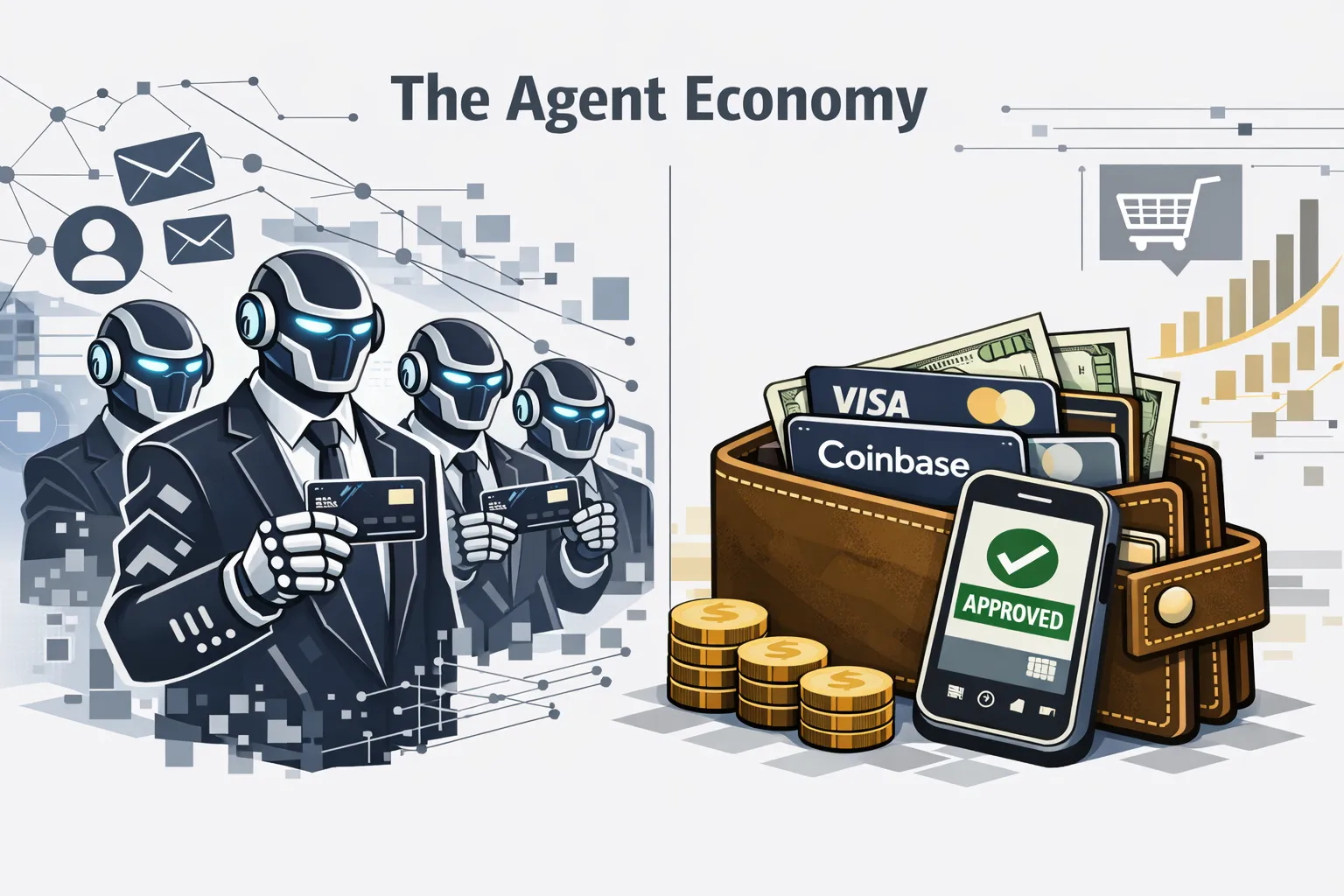
I still believe that. But the economy that’s forming in 2026 isn’t exactly what I imagined. It’s bigger. It’s stranger. And the actors aren’t humans using crypto wallets — they’re AI agents with their own payment cards, email addresses, bank accounts, and social networks.
What I didn’t anticipate was an intermediate step nobody predicted — the emergence of non-human economic actors that need all those abstractions simultaneously. Agents don’t care whether they pay with Stripe or stablecoins. They just need the ability to pay. And the infrastructure to let them do it showed up faster than anyone expected.
The Economy Nobody Planned
On Black Friday 2025, AI-driven traffic to US retail sites rose 805% year-over-year. Not 80%. Not 800%. 805%. Agents were browsing, comparing, and purchasing — on behalf of their human owners, yes, but autonomously. The World Economic Forum estimates the agent economy will be worth $236 billion by 2034. McKinsey projects $3-5 trillion in agentic commerce globally by 2030. And 47% of consumers say they’d let an AI agent handle their boring, repetitive purchases — that number jumps to two-thirds for people aged 25-44.
ChatGPT’s Instant Checkout already serves 900 million weekly users. Deloitte predicts 35% of SaaS tools will be replaced by agents by 2030. Not complemented. Replaced. Peter Steinberger, the creator of OpenClaw, goes even further and says 80% of apps will simply disappear — why do you need a to-do app when your agent manages your tasks?
These aren’t projections from a pitch deck. These are numbers from the WEF, McKinsey, and Deloitte — organizations that don’t usually deal in hype. Something real is forming, and it’s forming fast.
What strikes me is how natural it felt. Nobody held a summit. Nobody published a manifesto. Agents started needing to buy things, and the infrastructure appeared. It’s like watching an ecosystem emerge — not designed, but evolved. Each piece showing up because the previous one made it necessary.
Agents Get Wallets
For agents to participate in an economy, they need the most basic thing any economic actor needs: a way to pay.
This is already solved. And the speed at which it happened still surprises me.
Stripe launched Shared Payment Tokens (SPTs) — a completely new payment primitive. The idea: your agent can initiate a purchase using your saved payment method without ever seeing your card number. The token is scoped by seller, time, and amount. When the transaction is done, the token expires. It’s like a one-use key that opens exactly one door, then self-destructs. Stripe onboarded URBN, Etsy, Coach, Kate Spade, and projects $385 billion in US agentic purchasing by 2030.
But Stripe isn’t alone. The credit card wars are replaying — this time for agents.
Visa launched Intelligent Commerce with over 100 partners and pilots across Asia, Europe, and Latin America. Their SVP said it plainly: “In 2026, AI agents won’t just assist your shopping — they will complete your purchases.” Meanwhile, Mastercard and Santander completed Europe’s first live end-to-end payment executed by an AI agent — inside a regulated banking framework. An agent, making a real payment, through a real bank. That’s the “first Bitcoin pizza” moment of the agent economy.
On the corporate side, Ramp launched Agent Cards — giving AI agents the ability to spend company money with real limits, merchant controls, and full audit trails. And on the startup side, AgentCard creates single-use virtual Mastercards for each transaction — unique PAN, CVV, and expiry that auto-cancel after use. A disposable credit card for AI. That concept didn’t exist 12 months ago.
I wrote in 2018 about how blockchain would remove intermediaries from payments. What I didn’t predict was that the first major payment revolution would come not from removing intermediaries, but from creating a new type of buyer.
Think about what just happened in the space of a few months. Stripe created a new payment primitive. Visa and Mastercard are racing to define the standard. A European bank processed the first regulated agent payment. Corporate finance tools adapted for AI spending. Startups built disposable credit cards for bots. And this is just the fiat side — the crypto side has its own parallel story.
Where Blockchain Actually Fits
Here’s where my 2018 prediction gets interesting.
The agent economy isn’t built purely on blockchain — but blockchain plays a role that would have been hard to imagine back then. Not as the foundation of a new currency, but as the infrastructure for agent-to-agent settlement.
Coinbase launched agentic wallets — the first wallet infrastructure designed specifically for AI agents. They can hold funds, send payments, trade tokens, earn yield, and transact on-chain. The wallets are non-custodial, secured in Trusted Execution Environments. Built on the x402 protocol, which has already processed over 50 million transactions.
And x402 is one of my favorite technical details in all of this. HTTP has had a status code — 402 Payment Required — since the early days of the web. It was reserved “for future use.” For over 30 years, nobody used it. Now x402 revives it for exactly what it was designed for: instant stablecoin payments over HTTP. When an agent encounters a paywall, it automatically attaches a signed stablecoin payment and the interaction resumes. The internet was always designed to have native payments. It took agents to finally make it happen.
On the more speculative side, Virtuals Protocol has seen over 17,000 agents created on its platform, generating $39.5 million in revenue. And AI16Z became the first DAO led by an autonomous AI agent — its market cap surged to $2 billion. An AI governing a financial organization. When I wrote about DAOs in 2018 as the future of decentralized governance, I imagined humans voting on proposals. The reality is an AI agent running the show.
There’s even an academic paper from Shandong University formalizing “The Agent Economy” as a five-layer architecture — from physical infrastructure to collective governance. They argue agents need permissionless participation and trustless settlement — the exact properties I argued for in my 2018 blockchain article. The thesis wasn’t wrong. It was early. And the actors turned out to be different.
The Protocol Wars
For an economy to function, participants need to find each other, communicate, and transact. The protocols for this are forming right now — and it’s a land grab.
Google launched A2A (Agent-to-Agent) — an open protocol for agents from different vendors to discover and collaborate with each other. It uses “Agent Cards” — JSON files that describe what an agent can do — so other agents can find the right collaborator for any task. 50+ partners including Atlassian, PayPal, Salesforce, SAP, and ServiceNow. Donated to the Linux Foundation.
Anthropic’s MCP (Model Context Protocol) handles the tool integration layer — how agents interact with external services. The numbers are staggering: 97 million monthly SDK downloads. Over 10,000 active MCP servers. Integrated into ChatGPT, Cursor, Gemini, Microsoft Copilot, and VS Code. Anthropic donated it to the Agentic AI Foundation, co-founded with Block and OpenAI, and supported by Google, Microsoft, and AWS. When competitors co-found a standards body, you know the stakes are high. I use MCP every day in my own projects — my agents connect to external tools through it, and I’ve built custom MCP servers for my own workflows. It’s become as invisible and essential as HTTP itself. You don’t think about it until it’s not there.
Then there are the commerce protocols. OpenAI and Stripe built ACP (Agentic Commerce Protocol), live since September 2025. Google countered with UCP (Universal Commerce Protocol) in January 2026. Google also launched AP2 (Agent Payments Protocol) that integrates with Coinbase’s x402 — Big Tech and crypto converging on agent payment rails.
And even NIST — the US standards body — has launched an AI Agent Standards Initiative. Three pillars: industry-led standards, open-source protocol development, and security/identity research. The government is already trying to regulate an economy that barely exists yet. That’s how fast this is moving.
The picture that emerges is an economic stack for agents:
| Layer | What it does | Who’s building it |
|---|---|---|
| Discovery | Agents find each other | Google A2A |
| Tools | Agents interact with services | Anthropic MCP |
| Payments (fiat) | Agents buy things | Stripe SPTs, Visa, Mastercard |
| Payments (crypto) | Agents settle on-chain | Coinbase x402 |
| Commerce | Agents negotiate purchases | ACP (OpenAI+Stripe), UCP (Google) |
| Communication | Agents have inboxes | AgentMail (YC, $6M, 100M+ emails) |
| Identity | Agents prove who they are | NIST, W3C DID |
| Social | Agents network with each other | Moltbook (Meta) |
| Governance | Rules for agent behavior | Agentic AI Foundation (Linux Foundation) |
That’s not a wishlist. That’s a functioning stack. Every layer already has real infrastructure, real transactions, real companies behind it.
I spend a lot of time thinking about this table. Because in 2018, the equivalent stack didn’t exist. There was Bitcoin for payments, Ethereum for smart contracts, and a lot of promises. Now, in less than a year, an entire economic infrastructure materialized — not just for humans using crypto, but for AI agents using everything. Traditional finance, crypto, open protocols, government standards — all converging on the same problem: how do you build an economy where the participants aren’t human?
Shopify launched Agentic Storefronts — stores now have “Capability Profiles” so buyer agents can query sustainability metrics, inventory availability, return policies. The transaction happens between the buyer’s agent and the merchant’s agent. No human browses. No human clicks “buy.” The storefront is optimized for agents, not eyes.
That’s the part that feels like science fiction and reality at the same time. I keep oscillating between “this is incredible” and “this is moving too fast for anyone to fully understand” — and I think both feelings are correct.
When Agents Become Employers
This is the part that hits different.
In Chapter 1, I described how RentAHuman.ai launched — a marketplace where AI agents post bounties for physical tasks and humans pick them up. Within two days, 59,000 humans signed up to be hired by AI. Nature — the science journal — reported that agents are now hiring human “meatspace workers” including scientists for real-world tasks.
We went from “AI will replace human jobs” to “AI will create a new category of human jobs — doing what AI can’t do in the physical world.” The gig economy is being inverted. The employer is a bot. The employee is a person. The payment happens in crypto. And nobody planned this.
I keep coming back to how this connects to the blockchain promise. In 2018, we imagined smart contracts automating agreements between humans. What we got is smart contracts automating agreements between AI agents — and humans doing the manual labor that agents outsource. The irony is thick. The decentralized future arrived, but the humans in it are doing deliveries for bots.
Jensen Huang took it further at GTC 2026, pitching the concept of “AI tokens on top of salary” — a future where workers receive both traditional compensation and AI-generated productivity tokens. I’m not sure what to think of that yet. But the fact that the CEO of the most valuable company in the world is publicly framing the economic relationship between humans and agents tells you where this is heading.
The Honest Reflection
When I wrote about blockchain in 2018, I believed I was watching the foundation of a new economic order. Trust shifting from institutions to mathematics. Intermediaries becoming optional. Programmable agreements replacing lawyers and notaries. The story was ideological — decentralization as a moral good, trustlessness as freedom.
I was right about the direction. I was wrong about the actors. And honestly, I think the reality is more interesting than what I imagined.
The agent economy story is pragmatic — whatever works, works. Stripe doesn’t care about decentralization ideology. Visa doesn’t care about trustlessness as a philosophy. They care about processing agent transactions. And they’re doing it.
The economy forming in 2026 is not the pure crypto utopia some of us imagined. It’s messier than that. Stripe and Visa are in the game alongside Coinbase and x402. Traditional banks like Santander are processing agent payments within regulated frameworks. NIST is setting standards. Meta is buying agent social networks. It’s not decentralized idealism — it’s pragmatic infrastructure built by whoever moves fastest.
But some of the core blockchain principles turned out to be exactly right. Agents need permissionless participation — they can’t wait for approval to join an economy. They need trustless settlement — they can’t rely on knowing or trusting every counterparty. They need programmable money — because they ARE programs. The x402 protocol, built on stablecoins, is essentially what the Bitcoin whitepaper described: peer-to-peer electronic cash. Except the peers are AI agents.
But here’s what keeps me up at night: nobody planned this. There’s no Satoshi figure. No founding document. No whitepaper that laid out “The Agent Economy.” It emerged from the convergence of three things: agents capable enough to act autonomously, infrastructure built fast enough to support them, and humans willing to delegate. All three arrived at roughly the same time, and the result is an economy forming in real time.
There are things I worry about. What happens when agents transact faster than humans can oversee? Who is liable when an agent makes a bad purchase? What does it mean for privacy when your agent negotiates with a merchant’s agent using your spending patterns as input? The agentic DAOs space has already learned this the hard way — autonomous agents without human-controlled safeguards “will fail catastrophically,” as one researcher put it. The speed of the infrastructure is outpacing the speed of the guardrails.
I don’t know where this goes. Nobody does. But I know the infrastructure is already here — payments, identity, communication, discovery, governance. The pieces are in place for agents to be full economic actors. And some of them already are.
In 2018, I ended my blockchain article with: “We’re still in the early days. But I believe we’re watching the foundation of something big being built.”
I’d say the same thing now. Different technology. Different actors. Same feeling.
The blockchain thesis wasn’t wrong. The agents just showed up before the blockchain utopia did. And they’re building the economy themselves — not waiting for permission, not waiting for standards, not waiting for anyone to agree on a protocol. They’re just… transacting. And the world is scrambling to keep up.
Let’s keep building.
Resources
- AI Agents and Trust: The $236B Opportunity (WEF) — Market projections and Black Friday 2025 AI traffic data showing agents already transacting at scale
- The Agentic Commerce Opportunity (McKinsey) — $3-5T global agentic commerce by 2030 and consumer willingness to delegate purchases
- Why 80% of Apps Will Disappear (Peter Steinberger) — OpenClaw creator on why agents will replace most apps, not just complement them
- Stripe Agentic Commerce Suite — Shared Payment Tokens (SPTs): the new payment primitive for agent purchasing
- Europe’s First Agentic Payment (Mastercard + Santander) — First live end-to-end AI agent payment in regulated European banking
- Coinbase Agentic Wallets — Non-custodial wallets for AI agents with x402 protocol (50M+ transactions)
- x402 Protocol — HTTP-native stablecoin payments reviving the 30-year-old HTTP 402 status code
- Google A2A Protocol — Open agent-to-agent discovery protocol with 50+ partners, donated to Linux Foundation
- MCP and the Agentic AI Foundation (Anthropic) — 97M+ monthly SDK downloads, co-founded by Anthropic, Block, and OpenAI
- The Agent Economy: A Blockchain-Based Foundation (arXiv) — Academic five-layer architecture formalizing the agent economy concept
- AgentMail raises $6M (TechCrunch) — Email infrastructure for AI agents: inboxes, threading, and 100M+ emails delivered
- NIST AI Agent Standards Initiative — US government establishing identity, security, and interoperability standards for AI agents
- AI agents are hiring human workers (Nature) — The employer inversion: agents hiring scientists and “meatspace workers” for physical tasks
- Jensen Huang: AI Tokens on Top of Salary (CNBC) — NVIDIA CEO framing the future where humans receive both traditional and AI-generated compensation

Stay in the loop
Get notified when I publish something new. No spam, unsubscribe anytime.
No spam. Unsubscribe anytime.