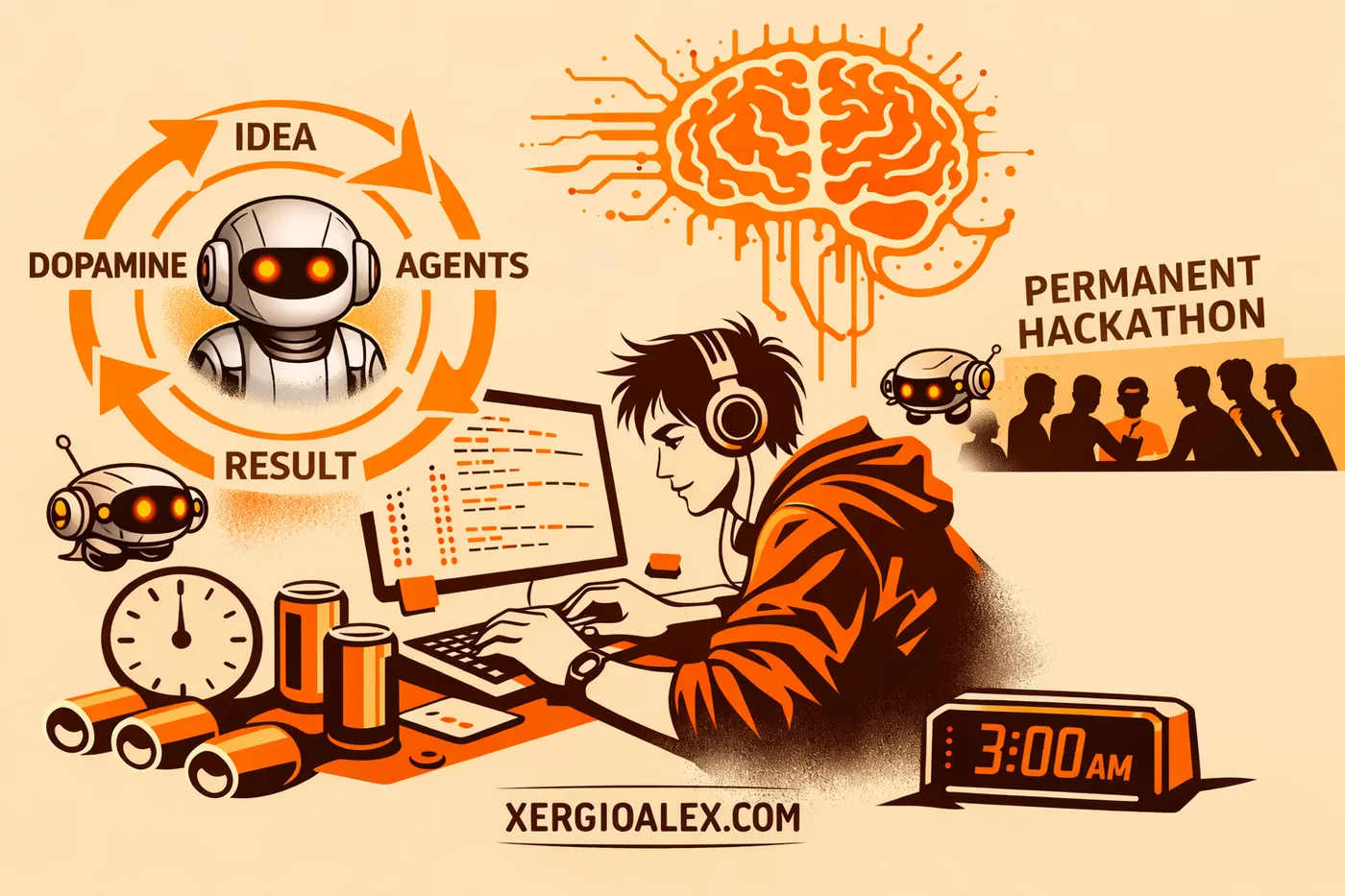
Recently, I was at a great Pereira Tech Talks meetup — a special one for International Women’s Day. After the talks, during the networking, I ended up in a circle with a few friends: developers, tech leads, engineers. The kind of conversation that starts with “what are you building?” and spirals from there. At some point we ended up talking about how we’re constantly burning through our Claude Code Max or Cursor Ultra subscriptions, stacking tools on top of tools, and feeling this inexplicable need to consume every last token — checking usage dashboards not to see if we spent too much, but to make sure we’re spending enough.
Then someone said the thing out loud that I think we’d all been thinking but hadn’t named:
“We’re addicted.”
The whole circle went quiet for a second. Not in disagreement — in recognition. Everyone was nodding. And the conversation that followed was one of the most honest I’ve had in a long time. Because it wasn’t about the tools anymore. It wasn’t about which model is better or which workflow is more efficient. It was about what these tools are doing to us. To our brains. To our relationship with rest.
And I realized: this is the chapter of the series I need to write. What happens to the human on the other side of the loop.
The Loop
Here’s what I can’t explain to people who haven’t experienced it.
You have an idea. Maybe it’s a feature, maybe it’s a side project, maybe it’s just a random thought late at night. Before agents, that idea would sit in a notes app for weeks. You’d think about it, maybe sketch something, eventually decide if it was worth the investment. The friction was the filter. Building things took time, so you were selective about what you built.
Now you open your agent, describe the idea, and in 20 minutes — or a few hours — you have a working prototype. Something you can click, test, share. The thing that would have taken a week — done. And in that moment, something happens in your brain that I can only describe as a jolt of adrenaline. You look at the screen and think: I just made that. In 20 minutes. What else can I build?
And you start the next one.
I know what this looks like from the inside. I’ve caught myself on a weekend starting a personal project just because it excited me — not because anyone asked for it, not because it was urgent, but because the loop told me to. The idea appeared, the agent was right there, and the cost of trying was so low that not trying felt like the bigger waste.
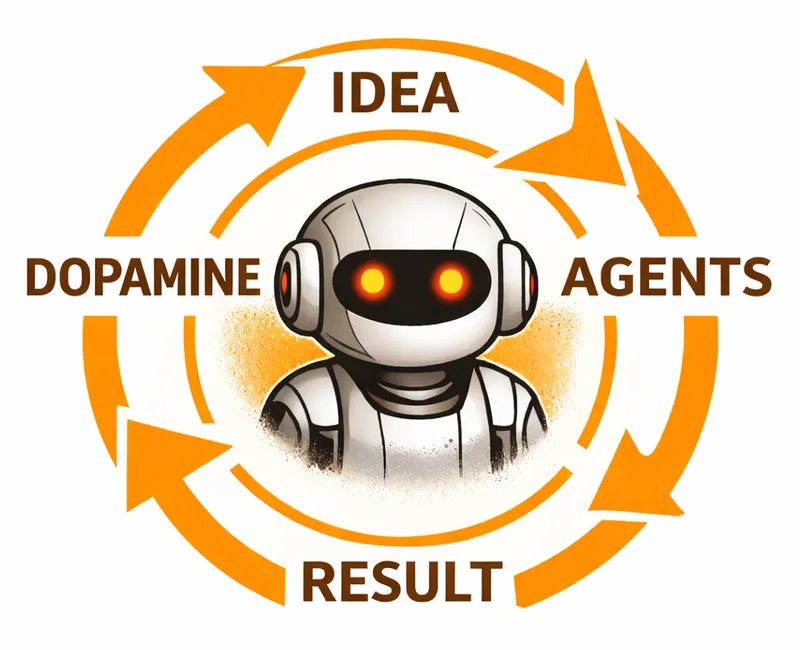
This is the loop. Idea → agent → result → dopamine → idea → agent → result → dopamine. It doesn’t stop. It doesn’t have a natural endpoint. Because the friction that used to slow you down — the hours of debugging, the setup, the boilerplate — is gone. The barrier between “I want to build this” and “it exists” collapsed to almost nothing.
I thought I was the only one feeling this way until that meetup conversation. I’m not. And I don’t think we’re a small group.
Why Your Brain Does This
I started digging into it and found there’s a lot of neuroscience behind what’s happening to us.
Dr. Anna Lembke, who runs the addiction medicine program at Stanford, wrote a book called Dopamine Nation that nails this. Her core framework: pleasure and pain are processed in the same brain region, and they work like a balance. Every time you experience pleasure, the brain compensates by tipping toward pain — creating a deficit. Repeat the stimulus, and the brain builds tolerance. You need more to get the same hit. She literally called the smartphone “the modern-day hypodermic needle, delivering digital dopamine 24/7.” If that’s the smartphone, I feel like coding with agents is becoming something similar.
But it goes deeper. Psychology Today documented something that explains the compulsion perfectly: dopamine drives the wanting system, not the liking system. The wanting system is stronger. And here’s the key — the wanting system has no built-in satiation mechanism. It just keeps seeking. “It’s not the reward itself that keeps the dopamine loop going,” they write, “it’s the anticipation of the reward.” Think about that. The moment between typing the instruction and seeing the result — that anticipation — is where most of the dopamine fires. Not when you see the code. When you’re waiting to see the code.
Then there’s flow state. Csikszentmihalyi’s research on flow — the state where you lose track of time and everything clicks — showed that it involves dopamine, norepinephrine, endorphins, anandamide, and serotonin all firing simultaneously. Five neurochemicals at once. That’s why flow feels so good. But here’s what Csikszentmihalyi himself warned: flow activities “can become addictive, at which point the self becomes captive of a certain kind of order and unwilling to cope with life’s ambiguities.”
Before agents, flow state in coding was fragile. You’d get interrupted by syntax errors, documentation lookups, dependency conflicts, deployment issues. Every interruption broke the flow. Now the agents handle all of that. The flow runs uninterrupted for hours. Five neurochemicals, no interruptions, no natural stopping point.
And the worst part? AI coding is a variable-ratio reinforcement schedule — the same mechanism that makes slot machines addictive. Sometimes the agent writes perfect code. Sometimes it hallucinates. That unpredictability is what makes it most addictive, according to behavioral psychology. Consistent rewards are less addictive than inconsistent ones. The times when Claude nails something complex on the first try feel even better because they’re not guaranteed.
It’s not a metaphor. It’s the same mechanism. We’re pulling the lever.
Rachel Thomas at fast.ai wrote about this and gave it a name that stuck with me: “dark flow.” She cites Csikszentmihalyi’s own warning about what he called “junk flow” — “when you are actually becoming addicted to a superficial experience that may be flow at the beginning, but after a while becomes something that you become addicted to instead of something that makes you grow.” That distinction between flow that makes you grow and flow that just feeds itself — I think about that a lot now.
The Illusion of Free Time
There’s a lie we all told ourselves: AI will make us more efficient, and efficiency means more free time. We’ll work less. We’ll rest more. We’ll finally have those four-day work weeks everyone’s been talking about.
The irony is that many of us say: “I can now build in a couple of hours what used to take me a week.” And the obvious question would be: so why don’t we rest the rest of the week? The answer is simple — we don’t rest. We build five more things.
It turns out there’s a name for this, and it’s 160 years old.
In 1865, economist William Stanley Jevons noticed something counterintuitive: when steam engines became more efficient and used less coal per unit of work, total coal consumption didn’t decrease — it increased. More efficiency made coal-powered machines viable for more applications, which created more demand. He called it the Jevons Paradox. Even Satya Nadella acknowledged it: “Jevons paradox strikes again! As AI gets more efficient and accessible, we will see its use skyrocket, turning it into a commodity we just can’t get enough of.”
We’re living it. Harvard Business Review published a study based on an eight-month observation at a tech company, and their conclusion was blunt: “You had thought that maybe… you can work less. But then really, you don’t work less. You just work the same amount or even more.” They found three forms of intensification: task expansion, blurred boundaries between work and rest, and increased multitasking. AI didn’t reduce the work — it intensified it.
Fortune captured it even better with a quote from Mike Manos, CTO at Dun & Bradstreet: “I got the eight hours to two hours, but now I can get 20 hours of work.” Read that again. He didn’t take six hours off. He filled them with more work.
And this isn’t new. Not even close. In 1983, Ruth Schwartz Cowan published More Work for Mother — a book documenting how household technologies like washing machines and vacuum cleaners did not reduce housework hours. They raised the standards. Washing machines didn’t mean less laundry — they meant you were expected to wash more often. Vacuums didn’t mean less cleaning — they led to wall-to-wall carpeting that required more cleaning. Every efficiency tool in history has followed the same pattern: the gains get absorbed by rising expectations.
AI coding tools are the washing machine of software engineering. We’re not doing less laundry. We’re just washing faster and washing more.
The Permanent Hackathon
84% of developers now use or plan to use AI tools — up from 76% the year before and 70% the year before that. The curve only goes up. And it’s not just casual adoption: Cursor went from $100M to $2B in annualized revenue in 18 months — the fastest growth of any SaaS company in history. Those numbers don’t reflect curiosity. They reflect compulsion.
Simon Willison — one of the most prolific open-source developers I follow — has 77 HTML/JS apps in a single repo, all built by prompting LLMs. He says something that hits hard: “It’s not about getting work done faster, it’s about being able to ship projects I wouldn’t have justified spending time on at all.” Those 77 projects aren’t making him money. They aren’t client work. They’re things he built because he could. Because the barrier dropped and the dopamine said yes.
And it’s not just indie developers. Armin Ronacher — the creator of Flask, one of the most respected developers in the Python community — confessed openly: “When I first got hooked on Claude, I did not sleep. I spent two months excessively prompting the thing and wasting tokens… Quite a few of the tools I built I felt really great about, just to realize that I did not actually use them.” Two months without sleeping properly. Building tools he never used. That’s not productivity. That’s compulsion.
Quentin Rousseau, CTO of Rootly, wrote a piece called “One More Prompt” that collected some of the most striking confessions. Garry Tan, the CEO of Y Combinator, said it publicly: “Claude Code this week has awakened my 25 year old self: the one that chugged red bulls and stayed up til dawn coding.” And in another post he admitted staying up 19 hours straight, not sleeping until 5 AM, and later warning: “This is unhealthy by the way (speaking from experience). Try to get at least 6 hours of sleep per night when deeply addicted.” The CEO of Y Combinator is telling people to get at least six hours of sleep because he knows they won’t. Because he can barely manage it himself.
Steve Yegge, one of the most widely-read voices in software engineering, put it bluntly: “Agentic coding is addictive. You will hear it more and more often, because it bewitches people once they’ve got the hang of it.” He described having to run a “practiced escape plan every night to get my computer closed by 2 AM.” He has to physically flee his own desk to stop building.
And then there’s the case of Glenn Sanford, CEO of eXp Realty. He was coding 12-16 hours a day with AI tools, averaging 4 hours and 44 minutes of sleep, describing a literal “brain buzz” that wouldn’t stop. His body eventually gave out: he developed atrial fibrillation — a serious heart condition — from the sustained stress. He now limits himself to 3-4 hours of coding per day. The dopamine loop sent him to the emergency room.
This is the permanent hackathon. Not a weekend event. Not a sprint with a finish line. An ongoing state of building that never ends because the friction that used to end it — the exhaustion, the complexity, the time cost — no longer exists. We replaced the constraints that used to force us to stop with tools that let us keep going forever.
What the Dopamine Hides
Everything I’ve described so far sounds exciting — and it is. But it has a cost, and the data is starting to make that uncomfortably clear.
Harvard Business Review published a study on what they called “brain fry” — a term I think is going to stick. Their findings: 14% of workers who use AI tools report brain fry. 33% more decision fatigue. 39% increase in major errors. And — this one stopped me — a 39% rise in quit intentions. One quote from the study: “I end each day exhausted — not from the work itself, but from the managing of the work.”
They also found a sweet spot: maximum three AI tools. Beyond that, the coordination cost starts eating the productivity gains. I counted mine recently. I stopped at six.
TechCrunch ran a piece with a headline that should be framed on the wall of every developer: “The first signs of burnout are coming from the people who embrace AI the most.” The irony is cruel but precise. The people who love these tools the most are the first ones burning out. “Employees’ to-do lists expanded to fill every hour that AI freed up,” the article says, “and then kept going.” That’s us. That’s the meetup crowd. That’s the enthusiasts.
There’s a split happening that I think explains a lot of the exhaustion. Generating with AI is a flow state — it produces dopamine. Reviewing AI output is not a flow state — it produces decision fatigue. We’re addicted to the generating half of a two-part process. But we still have to do the reviewing half. And the gap between how good it feels to generate and how draining it feels to review is where the burnout lives. As one developer put it: “AI reduces the cost of production but increases the cost of coordination, review, and decision-making. And those costs fall entirely on the human.”
The Honest Conversation
At the meetup, after we’d been talking for a while, someone asked the obvious question: “So what do we do about it?” And the honest answer from the circle was: nothing groundbreaking. We didn’t have a five-step plan. We didn’t have a productivity framework to sell. What we had was awareness — the simple acknowledgment that this is happening to us, that it’s a real phenomenon with real neuroscience behind it, and that pretending it’s just “passion for building” isn’t the whole story.
I think the first step is just naming it. Not dramatizing it, not pathologizing it, not quitting your tools in some performative digital detox. Just… seeing it for what it is. A dopamine loop. The Jevons Paradox in action. A flow state that doesn’t have natural exits. An efficiency gain that raised the bar instead of giving us time back.
For me, the awareness has changed small things. I notice now when I’m starting a project late at night not because it matters but because the loop told me to. I notice when I check the billing dashboard and feel anxious that I haven’t used enough tokens. I notice when I feel the pull to start something new before I’ve finished the last thing. I don’t always resist it. But at least I see it.
I also think there’s something worth protecting in all of this. The excitement is real. The joy of building is real. Watching an agent construct something you imagined in minutes is one of the most incredible feelings in my career. I don’t want to lose that. I don’t want to become so self-aware that the magic disappears. The line between healthy excitement and compulsion is blurry — and I’m not sure anyone has found it yet.
What I do know is that the conversation at that meetup meant something. There’s a difference between being alone in a dopamine loop and being in a room full of people who nod when you describe it. We’re a community going through the same thing. And the only irresponsible move would be not talking about it.
The cycle is real. The dopamine is real. The permanent hackathon is real. And for many of us — maybe most of us working at the frontier — this isn’t going to slow down. The agents keep getting more capable. The friction keeps dropping. The loop keeps tightening.
I choose to keep building. But I choose it with eyes open now. Not because I think the alternative is better — I don’t — but because the difference between a virtuous cycle and a vicious one is whether you’re running it or it’s running you.
Let’s keep building. Eyes open.
Resources
- Anna Lembke — Dopamine Nation — Stanford’s addiction medicine framework: pleasure-pain balance, tolerance, and the dopamine deficit state
- AI Doesn’t Reduce Work — It Intensifies It (HBR) — Eight-month observational study documenting three forms of AI work intensification
- The AI Productivity Paradox: More Work, Not Less (Fortune) — How CTOs went from “8 hours to 2” to doing “20 hours of work”
- When Using AI Leads to “Brain Fry” (HBR) — Decision fatigue, error rates, and the productivity sweet spot of maximum 3 AI tools
- Why the AI world is obsessed with Jevons paradox (NPR) — The 160-year-old economic paradox that explains why efficiency leads to more consumption, not less
- The Dopamine Seeking-Reward Loop (Psychology Today) — Why anticipation drives more dopamine than the reward itself, and why the wanting system has no off switch
- Simon Willison — How I use LLMs to write code — 77 apps from LLM prompts: “It’s not about speed — it’s about building things I wouldn’t have justified before”
- Breaking the Spell of Vibe Coding (fast.ai) — Rachel Thomas on “dark flow,” Armin Ronacher’s two-month sleepless confession, and why junk flow mimics growth
- One More Prompt: The Dopamine Trap of Agentic Coding — Steve Yegge’s nightly escape plan, Garry Tan’s red bull confessions, and why agentic coding “bewitches” people
- The Dopamine Trap: The Rarely Discussed Source of Burnout (SUCCESS) — Glenn Sanford’s atrial fibrillation from 16-hour AI coding sessions and how he recovered
- The first signs of burnout come from AI’s biggest fans (TechCrunch) — Why the most enthusiastic AI adopters are the first to burn out

Stay in the loop
Get notified when I publish something new. No spam, unsubscribe anytime.
No spam. Unsubscribe anytime.