Astro and Svelte: Why I Believe They're the Future of Web Development
I remember when building a website was simple. You opened a text editor, wrote an HTML file, linked a CSS stylesheet, maybe dropped in a script tag for interactivity, and opened it in the browser. It worked. No bundlers, no transpilers, no dependency hell, no 47-step configuration before you could render “Hello World.”
That simplicity wasn’t a limitation — it was the web’s greatest feature. The barrier to entry was low. The feedback loop was instant. You wrote code, you saw results.
Then the industry decided that wasn’t enough.
The Over-Engineering Problem
Somewhere along the way, building for the web became unnecessarily complex. We started needing build pipelines to ship a landing page. React popularized component-based architecture, but with it came layers of abstraction — hooks, effects, dependency arrays, virtual DOM reconciliation. And the thing is, other frameworks followed suit.
I’ve worked primarily with Vue throughout my career, and I chose it precisely because of its promise of simplicity. Vue was born specifically to be a simpler alternative to React — Evan You created it after working with Angular at Google, wanting something more approachable. And for a long time, it delivered on that promise. Vue 2’s Options API was genuinely intuitive: data(), computed, methods, watch. Clean, organized, easy to reason about. I loved it. I built projects with it. I advocated for it.
But then Vue 3 arrived with the Composition API, and I started watching the same pattern unfold. The framework that I’d chosen because it was simpler than React was gradually becoming just as complex. Here’s what a basic interactive counter looks like in modern Vue:
<script setup>
import { ref, computed, watchEffect } from 'vue';

const count = ref(0);
const title = computed(() => `Count: ${count.value}`);

watchEffect(() => {
  document.title = title.value;
});
</script>

<template>
  <div>
    <p>Count: {{ count }}</p>
    <button @click="count++">
      Increment
    </button>
  </div>
</template>
It’s not terrible. But look at what happened: ref(), .value everywhere, computed(), watchEffect(), defineProps, defineEmits… Vue started as the “simpler React” and gradually absorbed much of the same complexity it was designed to avoid. The Composition API is powerful, but it added a learning curve that the Options API never had. And this is the simplest example. Add data fetching with composables, provide/inject for dependency injection, defineModel, defineExpose, and you’re looking at pages of boilerplate before you’ve written any actual business logic.
The irony isn’t lost on me. I chose Vue over React because of simplicity, and now Vue is walking the same path React walked years ago. Frameworks that start simple inevitably grow complex as they try to cover every use case. React did it first. Vue followed. Angular was born complex. It’s like a law of framework entropy — and it made me wonder: is there a framework that can resist this pull?
That’s what led me to Astro and Svelte.
The irony? Most websites are fundamentally content sites — blogs, portfolios, documentation, marketing pages, landing pages. They’re mostly static. A wall of text with some images, maybe a contact form or a search bar. And yet we ship a full JavaScript runtime — hundreds of kilobytes of framework code — to display content that hasn’t changed since the last build.
This is the over-engineering tax we pay every day. And it doesn’t have to be this way.
Astro: Back to the Origins
Astro changed everything for me. When I first discovered it, the feeling was immediate: this is what web development should have always been.
An Astro component looks like this:
---
const title = "Hello World";
const posts = await fetch('/api/posts').then(r => r.json());
---

<section>
  <h1>{title}</h1>
  <ul>
    {posts.map(post => (
      <li><a href={post.url}>{post.title}</a></li>
    ))}
  </ul>
</section>

<style>
  section { max-width: 800px; margin: 0 auto; }
</style>
Look at that. It’s HTML with superpowers. The frontmatter (between the --- fences) runs at build time — it fetches data, imports components, processes anything you need. The template below is essentially HTML with expressions. The styles are scoped. No virtual DOM. No runtime. No useEffect. No dependency arrays. No client-side hydration by default.
The output? Pure static HTML. Zero JavaScript sent to the browser unless you explicitly ask for it.
This is what I mean by “back to the origins.” Astro brings back the simplicity of writing an HTML file with a script tag, but with modern developer experience — TypeScript support, component architecture, build-time data fetching, and optimized output. The best of both worlds. No ref(), no .value, no useState. Just HTML.
The Philosophy: Ship Less, Deliver More
Astro is built on a radical premise: your website probably doesn’t need JavaScript. Not all of it, anyway. Most pages are content. Content doesn’t need a runtime. It needs HTML.
When you do need interactivity — a search bar, a navigation menu, a theme toggle — Astro uses an Islands Architecture. Instead of hydrating the entire page (like Next.js, Nuxt.js, or Gatsby), you hydrate individual components:
---
import Header from '@/components/layout/Header.svelte';
import BlogSearch from '@/components/blog/StaticBlogSearch.svelte';
---

<!-- Hydrate immediately — navigation needs to work right away -->
<Header client:load lang="en" />

<!-- Hydrate when visible — search isn't needed until scrolled to -->
<BlogSearch client:visible posts={posts} />

<!-- Everything else? Zero JavaScript. Pure HTML. -->
<article>
  <h1>{post.title}</h1>
  <p>{post.content}</p>
</article>
You control exactly when and how each interactive piece loads:
client:load— Hydrate immediately (critical UI)client:visible— Hydrate when scrolled into view (lazy)client:idle— Hydrate when the browser is idle (deferred)
A page with 95% static content and one search component? Only the search component ships JavaScript. Everything else is zero-cost HTML. This is granular control that traditional SPA frameworks simply don’t offer. In a Vue or React-based app, even a mostly-static page ships the entire framework runtime to the browser — tens of kilobytes of JavaScript before you’ve written a single line of your own code.
Svelte: The Perfect Companion
If Astro is the foundation, Svelte is its ideal partner. And I don’t say this lightly — I’ve worked primarily with Vue throughout my career, and I genuinely love Vue. But Svelte is different. It feels like the framework that should have existed from the start — like what Vue always wanted to be but couldn’t quite achieve because of its runtime-based architecture.
Svelte’s tagline is “Web development for the rest of us” — and it means it. Here’s that same counter in Svelte:
<script>
  let count = $state(0);
  let title = $derived(`Count: ${count}`);
</script>

<svelte:head>
  <title>{title}</title>
</svelte:head>

<p>Count: {count}</p>
<button onclick={() => count++}>
  Increment
</button>
Compare this to the Vue version above. No ref(). No .value to unwrap reactive references. No computed(). No imports from the framework. You declare state with $state(), derived values with $derived(), and the compiler figures out what depends on what. It generates the minimal DOM update code at build time — no virtual DOM diffing at runtime.
The result is code that reads almost like vanilla HTML with reactive sprinkles. It’s closer to the mental model of how the web actually works: you have markup, you have state, state changes update the markup. No layers of abstraction in between. It’s what Vue’s Options API felt like in its simplicity — but without the limitations that led Vue to the Composition API in the first place.
Svelte 5 Runes: Reactivity Done Right
Svelte 5 introduced Runes — a signal-based reactivity system that’s both more powerful and more explicit than previous versions. The key primitives are beautifully simple:
$state()— Declare reactive state$derived()— Compute values from other reactive values$effect()— Run side effects when dependencies change$props()— Receive component props with destructuring
Here’s a real example — a search component with filtering and pagination. First, the Vue 3 Composition API version:
<script setup>
import { ref, computed } from 'vue';

const props = defineProps(['posts', 'lang']);
const query = ref('');
const currentPage = ref(1);

const filtered = computed(() =>
  query.value.length > 2
    ? props.posts.filter(p => p.title.toLowerCase().includes(query.value.toLowerCase()))
    : props.posts
);

const paginated = computed(() =>
  filtered.value.slice((currentPage.value - 1) * 12, currentPage.value * 12)
);

const totalPages = computed(() => Math.ceil(filtered.value.length / 12));
</script>

<template>
  <input v-model="query" placeholder="Search posts..." />
  <article v-for="post in paginated" :key="post.id">
    <h3>{{ post.title }}</h3>
    <p>{{ post.description }}</p>
  </article>
  <span>Page {{ currentPage }} of {{ totalPages }}</span>
</template>
Now the same thing in Svelte:
<script>
  let { posts, lang } = $props();
  let query = $state('');
  let currentPage = $state(1);

  let filtered = $derived(
    query.length > 2
      ? posts.filter(p => p.title.toLowerCase().includes(query.toLowerCase()))
      : posts
  );

  let paginated = $derived(
    filtered.slice((currentPage - 1) * 12, currentPage * 12)
  );

  let totalPages = $derived(Math.ceil(filtered.length / 12));
</script>

<input bind:value={query} placeholder="Search posts..." />

{#each paginated as post}
  <article>
    <h3>{post.title}</h3>
    <p>{post.description}</p>
  </article>
{/each}

<span>Page {currentPage} of {totalPages}</span>
Look at the difference. In Vue you need ref() for every piece of state, .value to access it inside the script, computed() for derived values, defineProps for props, and the template uses v-model, v-for, :key directives. It works — I’ve written this exact kind of component in Vue dozens of times — but there’s friction everywhere. The .value unwrapping alone is a constant source of bugs when you forget it.
In Svelte, state is just $state(). Derived values are $derived(). Props are destructured from $props(). The template uses bind:value and {#each}. No .value. No imports from the framework. The compiler tracks what depends on what and generates the minimal update code. When query changes, filtered recomputes, which causes paginated and totalPages to update, and only the affected DOM nodes change. It’s reactive, efficient, and readable — with noticeably less ceremony.
Compiled, Not Runtime
Svelte’s core innovation is that it’s a compiler, not a library. While Vue ships a runtime (~30KB minified + gzipped) that handles virtual DOM diffing, reactivity proxies, and the template compiler in the browser, Svelte does all that work at build time. The output is vanilla JavaScript that makes surgical DOM updates — no intermediate representation, no diffing algorithm, no runtime reactivity system.
This is a fundamental architectural difference. Vue (and React) need a runtime in the browser because their reactivity systems — Vue’s Proxy-based reactivity, React’s reconciliation — operate at runtime. Svelte doesn’t. The compiler analyzes your code and generates the exact DOM operations needed. No runtime, no overhead.
For an Astro site that already ships zero JavaScript by default, this matters enormously. When you do need an interactive island, Svelte ensures that island is as small as possible. Svelte components compile to an average of 30-40% less JavaScript than equivalent Vue or React components. The interactive layer of my own website — dozens of Svelte components covering search, navigation, lightbox, timelines, and more — compiles down to a fraction of what a Vue or React runtime would weigh.
Why Astro + Svelte Feel Made for Each Other
This is where the magic happens. Astro and Svelte share a fundamental philosophy: do the work at build time, not at runtime.
- Astro renders pages to static HTML at build time. Zero JavaScript by default.
- Svelte compiles components to minimal JavaScript at build time. No runtime framework overhead.
When you combine them, the result is a site where the static parts ship zero JavaScript and the interactive parts ship the absolute minimum. No Vue runtime. No React runtime. No virtual DOM. No hydration of content that was never interactive in the first place.
The syntax feels natural too. Astro components use a frontmatter + template pattern. Svelte components use a script + template pattern. Moving between them feels seamless — the mental model is consistent. You write what looks like HTML, with the logic where it belongs.
Here’s an example from my own website. The blog search is a Svelte component inside an Astro page:
---
// Astro: runs at build time
import StaticBlogSearch from '@/components/blog/StaticBlogSearch.svelte';
import { getBlogPosts } from '@/lib/blog';

const posts = await getBlogPosts('en');
---

<!-- Svelte component hydrated only when visible -->
<StaticBlogSearch client:visible posts={posts} lang="en" />
The data fetching happens at build time in Astro. The interactive search UI happens at runtime in Svelte. Each framework does what it does best. No overlap, no waste.
Compare this to a Vue-based approach where you’d need onMounted to fetch data, ref() to store it, a loading ref, an error ref, and you’d ship the Vue runtime just to display a search box. Or a React approach with useEffect and useState. In both cases: more code, more runtime, more weight. The Astro + Svelte approach is simpler and faster.
The Data Speaks
This is where my personal opinions meet industry reality. I love Astro and Svelte — but am I just a fanboy, or is the community actually moving in this direction?
The data says I’m not alone.
State of JavaScript 2025
The State of JS 2025 survey tells a compelling story. In the meta-frameworks category (where Astro properly competes), the results are striking:
- Astro is #1 in Satisfaction — with a commanding 39-point lead over Next.js
- Next.js satisfaction dropped from 68% to 55% year-over-year
- Svelte 5 topped Developer Experience ratings among front-end frameworks
- Svelte maintains an 88% retention rate — among the highest for any framework
The survey commentary puts it directly: “The main battle has moved to the realm of meta-frameworks, with Astro making a serious attempt at Next.js’s crown.”
And another quote that caught my attention: “One look at the Awareness chart shows how dangerous of a competitor Astro really is.”
This wasn’t a niche survey. This is the State of JavaScript — one of the largest developer surveys in the ecosystem.
State of JavaScript 2024 (The Year Before)
The 2024 edition was equally telling:
- Astro ranked #1 in Interest, #1 in Retention, and #1 in Positivity in meta-frameworks
- Astro’s usage rose from 4th to 2nd place, trailing only Next.js
Two consecutive years of dominance across every sentiment metric. That’s not a fluke — it’s a trend.
Rising Stars of JavaScript 2025
JavaScript Rising Stars 2025 tracks GitHub star growth as a proxy for developer interest:
| Project | Category | Stars Added | Rank |
|---|---|---|---|
| Astro | Overall | +7,200 | #5 |
| Astro | Static Sites | — | #3 |
| Svelte | Front-end Frameworks | +4,600 | #3 |
The Rising Stars commentary: Astro “keeps shining as a versatile framework to build content-heavy applications with a great developer experience and a focus on performance.”
Stack Overflow Developer Survey 2025
The Stack Overflow 2025 survey (49,000+ respondents across 177 countries) adds another dimension:
- Svelte: 53.7% admired — developers who use it love it
- Astro: growing faster among learners (7.7%) than professionals (4.3%) — indicating a strong growth trajectory as new developers adopt it
When a framework has higher adoption among people learning to code, it signals that the future is moving in its direction. Those learners become tomorrow’s professionals.
The Aggregate Picture
| Metric | Value | Source |
|---|---|---|
| Astro satisfaction lead over Next.js | 39 points | State of JS 2025 |
| Svelte retention rate | 88% | State of JS 2025 |
| Astro NPM downloads growth | 360K → 900K+/week (2.5x) | Astro Year in Review |
| Astro GitHub stars | 55,200+ | GitHub |
| Astro GitHub YoY growth | 78% | GitHub Octoverse 2025 |
| Astro releases in 2025 | 113 | Astro Year in Review |
| Astro users who’d keep using it | 87% | Developer surveys |
| Svelte admiration rate | 53.7% | Stack Overflow 2025 |
These aren’t marginal differences. Astro’s satisfaction lead is 39 points. Its download growth is 2.5x in a single year. Svelte’s retention is 88%. These are frameworks that developers actively choose and then keep choosing.
Performance That Proves the Philosophy
Philosophy is nice. Data is better. But performance benchmarks are where Astro and Svelte truly shine — because their architectural decisions translate directly into measurable results.
The JavaScript Diet
Astro ships 90% less JavaScript than Next.js for equivalent static content:
| Metric | Astro | Next.js |
|---|---|---|
| Homepage JS bundle (gzipped) | ~8 KB | ~85 KB |
| JS reduction | — | 90% more |
| React runtime included | No | Yes |
| Virtual DOM shipped | No | Yes |
In a real-world comparison, a Next.js site bundled 180 KB of JavaScript for the same content that Astro delivered with just 18 KB. That’s not optimization — that’s a fundamentally different architecture.
Lighthouse Scores
Astro sites consistently achieve Lighthouse Performance scores of 98-100. Not with careful optimization — by default. Because when you ship zero JavaScript, there’s nothing to slow down the page.
Real-world migrations tell the story:
- WordPress to Astro: Lighthouse scores jumping from the 70s to 96+
- LCP (Largest Contentful Paint) improvements from 3.2s to 1.6s
- 60% of Astro sites achieve “Good” Core Web Vitals scores, compared to 38% for WordPress and Gatsby
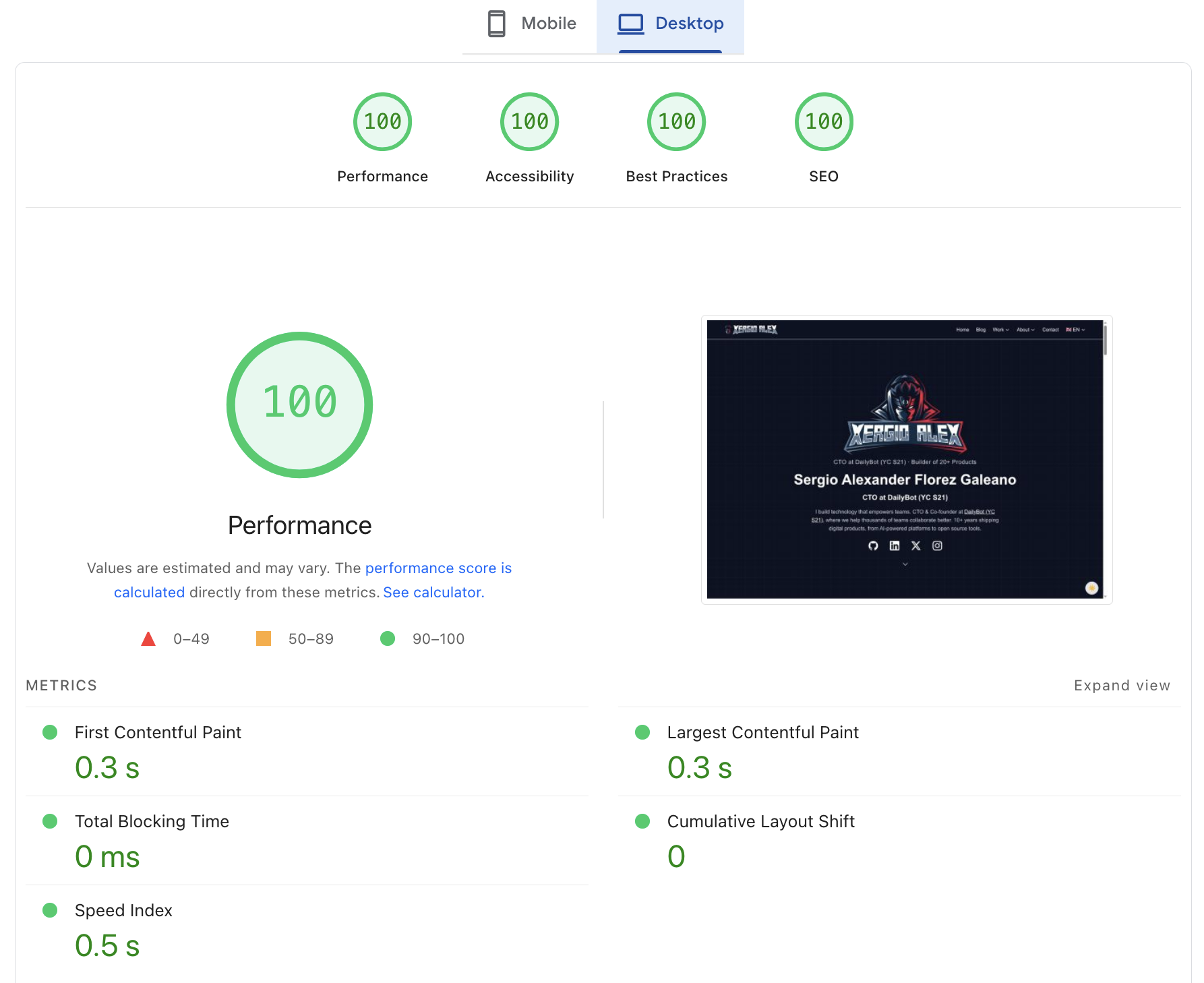
On my own site, xergioalex.com, the results speak for themselves. This isn’t a simple landing page — it’s a site with a fairly complex architecture: a growing blog in two languages, client-side search, interactive timelines, image lightboxes, dark mode, bilingual routing, RSS feeds, and dozens of Svelte interactive components. And yet, with some iteration and fine-tuning, it achieves a perfect 100 in all four PageSpeed categories — Performance, Accessibility, Best Practices, and SEO — on both mobile and desktop:
Desktop — 100/100/100/100:
Mobile — 100/100/100/100:
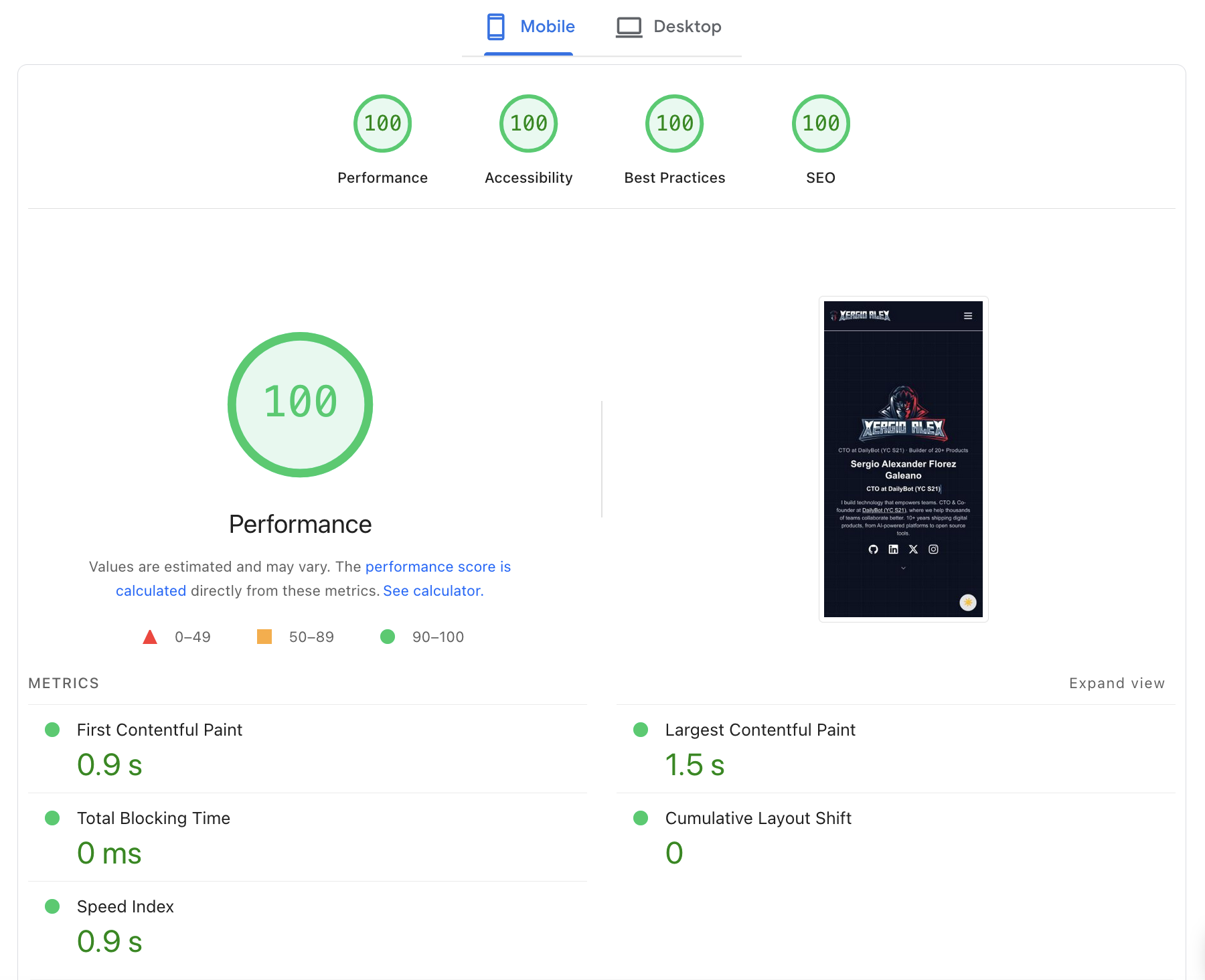
Look at those metrics. On desktop: 0.3s FCP, 0.3s LCP, 0ms TBT, 0 CLS, and 0.5s Speed Index. On mobile: 0.9s FCP, 1.5s LCP, 0ms TBT, 0 CLS, and 0.9s Speed Index. All green. All perfect. Achieving a quadruple 100 on desktop is already impressive, but getting it on mobile too — where devices are slower, connections are weaker, and Google’s throttling simulation is far more aggressive — is where the real challenge lies. For a site with this level of content and interactivity, these numbers would be extremely difficult to achieve with Vue + Nuxt, React + Next.js, or any traditional SPA framework — not impossible, but it would require significantly more effort and optimization work. With Astro + Svelte, it took some iteration, but the architecture works with you instead of against you. The framework’s defaults are already fast; you just need to avoid actively slowing things down.
If you want the complete story of what it took to go from Astro’s excellent defaults to a perfect quadruple 100 — the CSS-only Typewriter that eliminated JavaScript from the critical path, the WCAG AA accessibility audit, the SVG optimization, the hydration directive audit, and more — I wrote a dedicated deep dive: The Road to 100: How I Achieved Perfect Lighthouse Scores on Every Category.
Why This Matters
Performance isn’t a vanity metric. It directly impacts:
- User experience — Pages that load in under 2 seconds feel instant. Pages that take 5+ seconds feel broken.
- SEO — Google’s Core Web Vitals are a ranking factor. Faster sites rank higher.
- Accessibility — Users on slow connections or old devices benefit most from less JavaScript.
- Cost — Less JavaScript means less bandwidth, less CPU usage, lower hosting costs.
When Astro and Svelte deliver these results by default — without spending weeks on performance optimization — that’s a genuine architectural advantage.
The Cloudflare Acquisition: A $40B+ Bet on Astro
In January 2026, something happened that validated everything I’d been feeling about Astro. Cloudflare acquired The Astro Technology Company.
Let that sink in. A company with a market cap exceeding $40 billion — one of the most important infrastructure companies on the internet — decided that Astro was so important to the future of the web that they acquired the team behind it.
Cloudflare CEO Matthew Prince put it clearly: “By acquiring this talented team and committing to one of the most impactful frameworks when it comes to speed and performance, we’re going to ensure Astro continues to be the best web framework for content-driven websites, not only as it is today but for years to come.”
What makes this acquisition remarkable:
- Astro remains MIT-licensed, open-source, and platform-agnostic. You can still deploy Astro anywhere — Vercel, Netlify, AWS, or your own server. This isn’t vendor lock-in.
- The team can now focus entirely on framework development instead of building a commercial business around it.
- Financial backing from the ecosystem — Webflow ($150K), Cloudflare ($150K), Mux ($5K/month), plus Netlify, Wix, and Sentry contributing to the Astro Ecosystem Fund.
Fred Schott, Astro’s founder, noted that Cloudflare and Astro share the same vision: “Content remains at the center” of the web’s future. Cloudflare approaches it from the infrastructure side; Astro works from the framework side.
This isn’t a startup experiment anymore. This is institutional validation that content-first, performance-first web development is the direction the industry is heading.
Enterprise Adoption
It’s not just surveys and acquisitions. Astro is being used in production by some of the world’s largest companies:
- Microsoft — Built their Fluent 2 Design System documentation with Astro, building new pages in half the time
- Google — Uses Astro for content-driven properties
- Firebase — Migrated their blog from Blogger to Astro, reducing publishing time from hours to minutes and build time by 75%
- Trivago, Visa, NBC News, Unilever — All using Astro in production
These aren’t small companies experimenting with a new toy. These are organizations with millions of users, where performance, reliability, and developer productivity directly impact the bottom line.
And the adoption is accelerating. 18% of surveyed developers now use Astro, and 87% of Astro users plan to keep using it — the highest retention intent among all SSGs surveyed. When the vast majority of people who try a tool decide to keep using it, that tells you something about the quality of the experience.
My Experience: This Site Is the Proof
I didn’t just read about Astro and Svelte — I built my entire personal platform with them. XergioAleX.com is living proof that this stack works.
The site has:
- A growing blog in two languages (English and Spanish)
- Full bilingual architecture — every page, every UI string, every blog post exists in both languages
- Client-side search powered by a static JSON index, lazy-loaded with
requestIdleCallback - Dozens of interactive Svelte components — navigation, search, lightbox, timelines, and more
- Dark mode with system detection and localStorage persistence
- RSS feeds, sitemap, SEO optimization — all built-in with Astro
The development experience has been genuinely enjoyable. I’ve written about it in detail in Building XergioAleX.com and presented the Astro philosophy in Astro in Action. The short version: building with Astro + Svelte feels like the early web with modern superpowers. I write components that look like HTML. I get TypeScript safety. I get blazing-fast builds. And the output is the leanest, fastest site I’ve ever shipped.
The entire interactive layer — search, navigation, lightbox, timelines, mobile menu, and more — compiles down to a fraction of what a Vue or React runtime would weigh. And those components only load when they’re needed, thanks to Astro’s islands architecture.
The Tech Stack That Powers It
For the curious, here’s exactly what’s running under the hood:
| Layer | Technology | Role |
|---|---|---|
| Framework | Astro 5.x | Static site generation, routing, Content Collections |
| Interactive UI | Svelte 5.x | Search, navigation, lightbox, timelines |
| Styling | Tailwind CSS 4.x | Utility-first CSS with dark mode support |
| Content | Markdown/MDX | Blog posts with frontmatter validation |
| Type Safety | TypeScript 5.x | Type-safe development across the entire pipeline |
| Linting | Biome | Fast linter and formatter (replaces ESLint + Prettier) |
| Deployment | Cloudflare Pages | Global CDN, edge caching, zero cold starts |
| Search | Fuse.js | Client-side fuzzy search, lazy-loaded |
Each choice reinforces the philosophy: the simplest tool that does the job well. Biome instead of ESLint + Prettier (one tool instead of two). Tailwind instead of CSS-in-JS (no runtime overhead). Cloudflare Pages instead of a server (static files on a CDN). Everything is chosen to minimize complexity and maximize performance.
Being Honest: When to Choose Something Else
I want to be clear about something: Astro is not the right tool for every project. And acknowledging this is what separates genuine advocacy from blind hype.
Astro excels at:
- Content sites — Blogs, portfolios, documentation, marketing pages
- Mostly-static sites — Where interactivity is the exception, not the rule
- Performance-critical sites — Where every kilobyte of JavaScript matters
- SEO-heavy sites — Where server-rendered HTML is essential
Astro is not the natural choice for:
- Fully interactive SPAs — Apps like Figma or Google Docs where literally 100% of the page is a live interactive canvas with no static content at all
And even then, that’s really the only case where I’d say Astro genuinely doesn’t fit. For the other cases people typically cite — real-time dashboards, complex state management apps — I think Astro handles them better than most people assume.
Real-time dashboards? Think about it: the sidebar, navigation, labels, and page structure are all static content — perfect for Astro. The live charts and real-time data? Those are Svelte islands with WebSocket connections. Astro’s server islands (introduced in Astro 5) and hybrid rendering mode make this architecture not just possible, but elegant. You get instant page loads for the static shell while each interactive widget hydrates independently.
Complex state management? Svelte 5’s runes ($state, $derived) combined with nanostores — which Astro officially recommends for cross-island state sharing — can handle surprisingly complex state orchestration. It’s not Redux, and that’s the point. You don’t need Redux-level ceremony when your reactive primitives are that expressive.
That said, for apps where interactivity dominates across every screen — a full SaaS with dozens of complex interactive views — Vue with Nuxt, React with Next.js, or Svelte with SvelteKit are more natural fits. Vue’s ecosystem is mature and battle-tested — I’ve built complex applications with it and it handles that kind of work well. React’s ecosystem is even larger. Those frameworks earned their place for app-heavy use cases.
But here’s the thing: the line between “content site” and “app” is blurrier than ever, and Astro keeps pushing that boundary. Most websites aren’t Figma. Most websites are a mix of content and interactivity — blogs, landing pages, documentation, portfolios, e-commerce catalogs, corporate sites, and yes, even dashboards with real-time elements. For those — which represent the vast majority of what gets built on the web — Astro and Svelte are not just competitive. They’re superior.
The Bigger Picture: A Return to Simplicity
What excites me most about Astro and Svelte isn’t just the technical merits. It’s what they represent: a movement back toward simplicity in web development.
The New Stack captured this perfectly in their 2024 analysis: “A return to simpler ways of building a website or web application, partly as a reaction against the increasing complexity of JavaScript frameworks.” And that complexity isn’t exclusive to React — as I described earlier, Vue has followed the same trajectory.
The State of JS 2025 survey observed something I find remarkable: “Something we haven’t seen in a decade: stagnation in frameworks, but an explosion in workflow. Developers aren’t switching tools because they’re bored — they are settling down because the tools finally work.”
The framework wars aren’t ending because developers gave up. They’re ending because frameworks like Astro and Svelte solved the right problems in the right way. When a tool simply works — when it’s simple to use, fast by default, and doesn’t fight you — developers stop looking for alternatives.
A TSH.io survey of 6,000 developers confirmed the trend: a “further shift away from complexity” in 2025, with Astro and Svelte “gaining popularity as more developers looked for solutions beyond the traditional SPA ecosystem.”
Astro reached a 25% adoption rate despite being relatively new. That’s not incremental growth — that’s a paradigm shift. And GitHub Octoverse 2025 identified Astro as the fastest-growing framework with 78% year-over-year growth.
Where I Think This Is All Going
I’ll be straightforward: I believe Astro and Svelte represent the future of web development. Or at least, the future I want to see — and the data suggests I’m not alone in wanting it.
Here’s my prediction:
-
Astro will become the default choice for content websites within the next 2-3 years, just as WordPress became the default two decades ago — but with vastly better performance and developer experience.
-
Svelte will continue growing as the preferred UI framework for developers who value simplicity and performance. Its 88% retention rate and consistent top rankings in developer satisfaction aren’t accidental — they reflect genuinely good design.
-
The “ship less JavaScript” philosophy will become mainstream. Not because it’s trendy, but because performance requirements (Core Web Vitals, mobile-first indexing, global audiences on varying connection speeds) make it necessary.
-
The Cloudflare acquisition accelerates everything. With institutional backing, Astro can now iterate faster, reach more developers, and invest in the ecosystem in ways an independent startup couldn’t.
Will Vue and React disappear? No. Vue has a mature ecosystem that I know well and respect. React has massive enterprise adoption and millions of developers. Both will remain important for complex interactive applications. But the era of using SPA frameworks as the default for everything — including static content sites where they were never the right tool — is ending.
The web started simple. HTML files, CSS styles, a sprinkle of JavaScript when needed. Astro and Svelte bring us back to that simplicity — with modern tooling, type safety, and performance that the early web could never have imagined.
Try It Yourself
If anything in this post resonated, here’s my suggestion: build something small with Astro and Svelte. A personal blog. A portfolio. A documentation site. You’ll feel the difference immediately — the simplicity of writing components that look like HTML, the speed of a site that ships zero JavaScript by default, the joy of a development experience that doesn’t fight you.
The community is growing fast. The tools are mature. The ecosystem is backed by a company that powers a significant portion of the internet. There has never been a better time to start.
Here are some resources to get started:
- Astro Documentation — Start here. The docs are excellent.
- Svelte Documentation — The interactive tutorial is genuinely one of the best in the industry.
- State of JS 2025 — See the full survey data for yourself.
- Rising Stars 2025 — GitHub star trends across the JS ecosystem.
- Astro Year in Review 2025 — The full growth story from the team.
- Cloudflare Acquires Astro — What the acquisition means for the future.
And if you want to see what a real Astro + Svelte site looks like in production, you’re looking at it right now. This site — xergioalex.com — is built entirely with this stack. Check out Building XergioAleX.com for the complete story, or Astro in Action for the talk that started my Astro journey.
Let’s keep building — but simpler, faster, and closer to the web’s original promise.