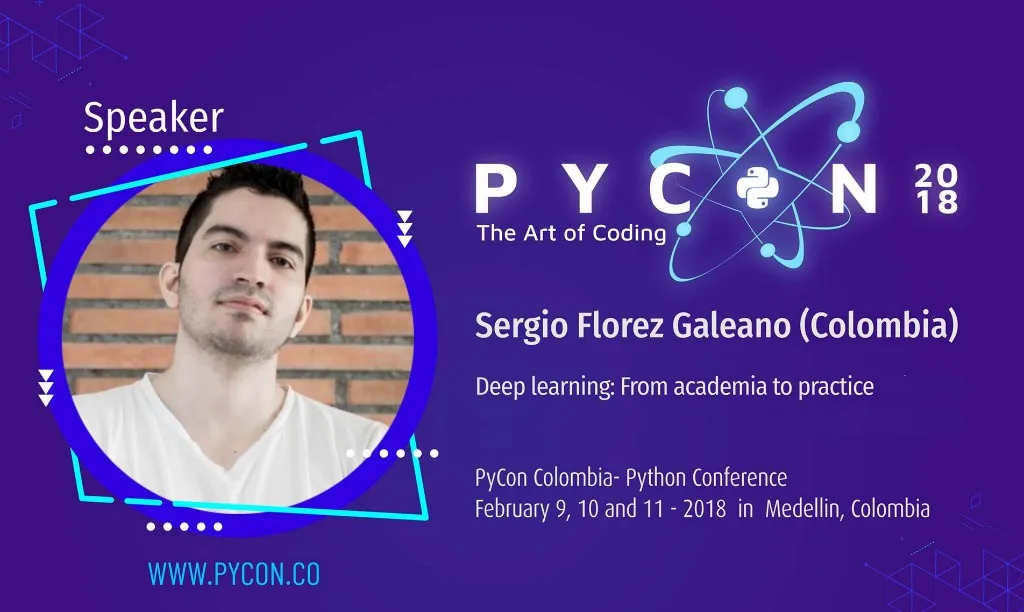
PyCon Colombia 2018 was a very special experience for me. I gave the talk Deep Learning: From Academia to Practice in Medellín and it was one of those presentations where I could connect something I’m passionate about — applied mathematics — with an audience of Python developers.
What I most wanted to convey was that behind AI models there’s no magic: there’s linear algebra, calculus, statistics, and graphs. Concepts many of us saw in university that, applied the right way, let us build systems that learn. I find that fascinating.
From AI to Machine Learning
I started by placing deep learning within the broader landscape. Artificial intelligence is often classified into levels: weak AI (specific tasks), strong AI (general), super AI, singularity. I also talked about biased algorithms — a topic we can’t ignore when building these systems.
Andrew Ng said that “AI is the new electricity.” In that context, machine learning is the field of AI focused on systems that learn autonomously. Learning, here, means finding complex patterns in millions of data points.
There are two main paradigms:
- Supervised learning — Making future predictions based on behaviors or characteristics already seen in the data. Classic example: classifying images (1 = cat, 0 = non-cat).
- Unsupervised learning — Using unlabeled historical data to explore its structure and organization.
Neural Networks and the Perceptron
Neural networks are the foundation of much of today’s AI. They work, at least conceptually, like the neurons in our brain. The perceptron is the fundamental building block — a unit that receives inputs, weights them, and produces an output.
From there we moved to predictions with Markov chains and other models, but the important leap is when we stack layers: that’s deep learning.
Deep Learning: Learning at Multiple Levels
Deep learning is learning at multiple levels. Each hidden layer is responsible for recognizing different characteristics and passing them as input to the next. Early layers capture simple patterns (edges, textures); deeper layers capture abstract concepts.
And here comes the part I was most excited to share: the math behind it.
The Mathematics That Makes Deep Learning Possible
To build these models we need:
- Linear algebra — Operations with vectors and matrices
- Calculus — Derivatives, gradients, optimization
- Statistics — Distributions, inference
- Graphs — Representation of networks and data flows
One of the key concepts I explained was vectorization: the art of getting rid of for loops in the code. Vectorized operations leverage SIMD (Single Instruction, Multiple Data) for data-level parallelism. That’s why GPUs are so important in deep learning — they’re designed for this kind of massive computation.
How It Works: Forward, Backward, and Gradient Descent
The flow of a deep learning model can be summarized as:
- Input X → passes through transformation layers (linear + non-linear operations) → Prediction Y
- A loss function compares the prediction with the real target
- An optimizer (like gradient descent) adjusts the weights to minimize that loss
The basic logistic regression formula: Z = Wx + b, followed by an activation function, gives us the prediction. The cost function measures how wrong we are. Gradient descent is the algorithm that searches for the minimum — where the derivative vanishes (f’(x) = 0).
There are two fundamental phases:
- Forward propagation — Data flows forward, layer by layer
- Backward propagation — The gradient flows backward, allowing us to update the weights
Computer Vision and Convolutional Networks
We closed with computer vision. I talked about spectrograms — representations of signals in the frequency domain — and convolutional neural networks (CNNs), which are the foundation of modern computer vision.
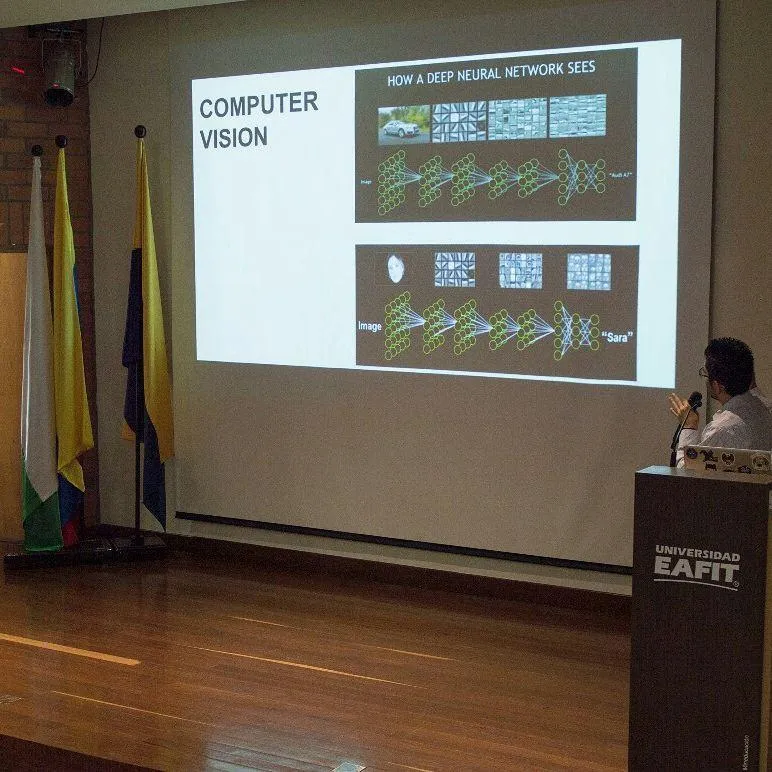
CNNs learn filters that detect edges, textures, and shapes. By stacking convolutional layers, the model can recognize complex objects. I mentioned deeplearning.ai as a resource to go deeper.
Resources
- View slides
- Watch the talk on YouTube
- My speaker profile at PyCon Colombia 2018
- Deep Learning Specialization (deeplearning.ai)
- PyCon Colombia
It was an honor to share the stage at PyCon Colombia 2018. Applied mathematics remains for me one of the most fascinating gateways to artificial intelligence.
Let’s keep building.