AEO: What Changes When AI Starts Answering Instead of Linking
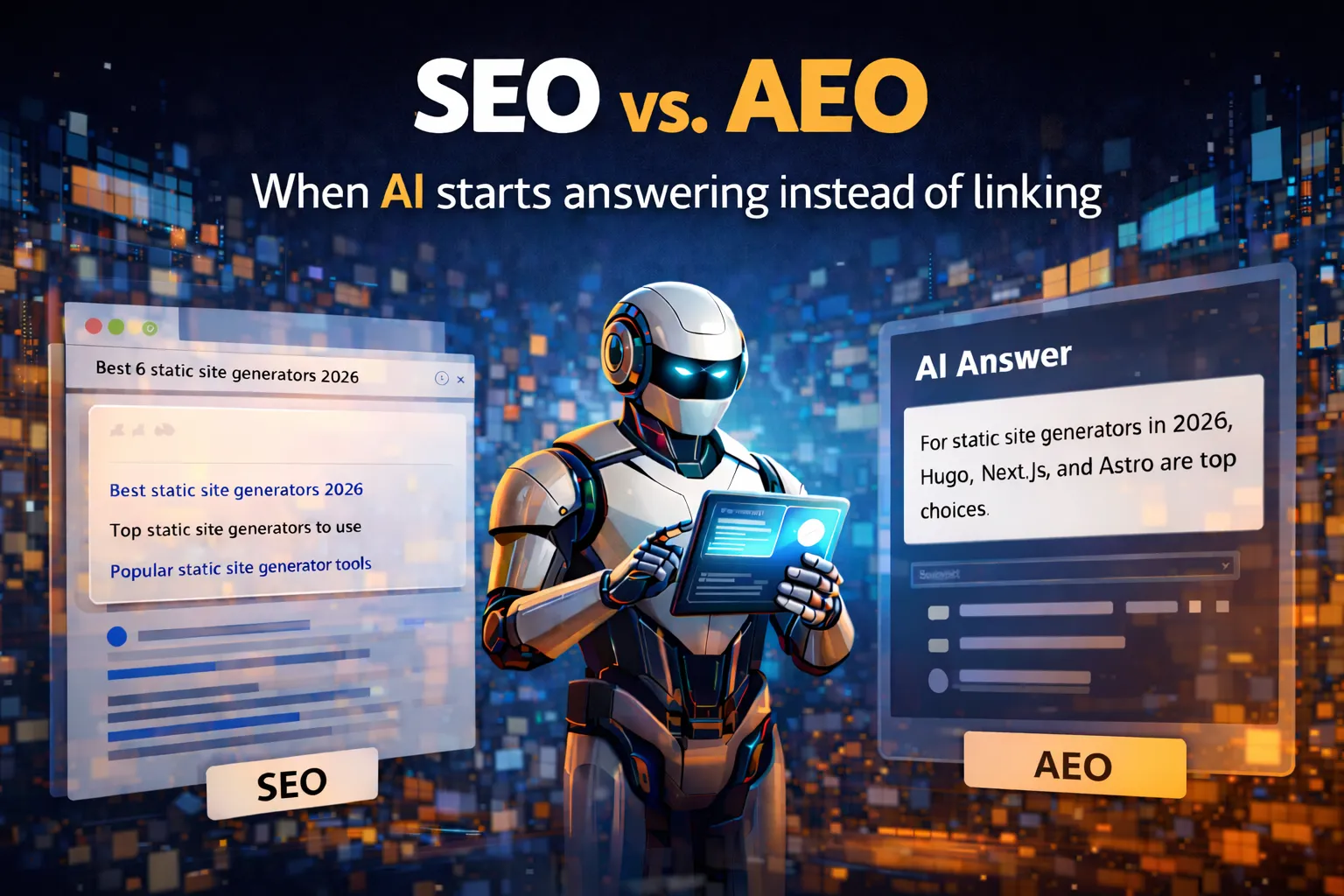
For most of the web’s history, optimizing for search meant one thing: get ranked. Put the right keywords in the right places, earn some backlinks, make sure Google could crawl you. If you did it well, you showed up in a list of ten blue links. Users clicked. That was the deal.
That deal has changed. Not gradually — abruptly, in the last 18 months.
When Google shows an AI Overview — an AI-generated summary that appears above the traditional results and answers the question directly — 83% of those searches end without a click. The user already has their answer. The ranked list below — the list we spent years building toward — goes untouched. And Google isn’t the only front to worry about. ChatGPT hit 900 million weekly active users in February 2026. Perplexity processes over 780 million queries per month. These platforms don’t show a list and let users decide — they synthesize, summarize, and cite. Either your content gets cited, or it effectively doesn’t exist for that query.
The metric that used to matter was ranking. The metric that matters now is citation.
The Big Picture
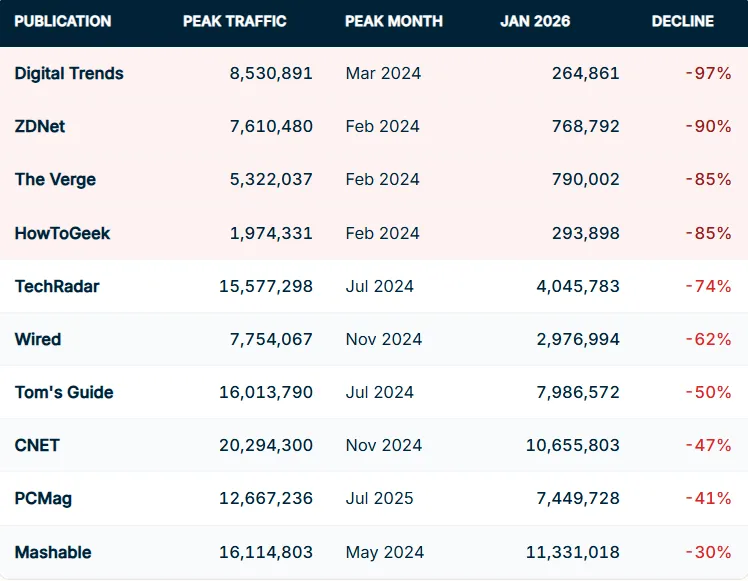
Gartner predicted in early 2024 that traditional search volume would drop 25% by 2026. With publisher referrals from Google down 38% and AI Overviews now appearing in roughly half of US searches, those numbers aren’t projection anymore. They’re current reality. The impact is already hitting hard: Growtika’s analysis shows that major tech publications have lost up to 97% of their organic traffic since mid-2024 — Digital Trends went from 8.5 million monthly visits to 265,000, ZDNet dropped 90%, The Verge 85%. These aren’t small blogs. These are some of the biggest names in tech media.
The platforms driving this aren’t niche or experimental. Google, ChatGPT, Perplexity, Claude — these are mainstream tools used by hundreds of millions of people who have simply changed how they ask questions. Instead of searching for “best static site generators 2026” and scanning results, they ask the AI directly. The AI reads a dozen sources, synthesizes an answer, and names two or three of them. If your content isn’t in that pool, the click never comes.
There’s another layer that gets less attention: AI agents acting on behalf of users. Not just answering questions but taking actions — researching a topic, comparing options, generating a brief. Those agents are crawling the web constantly, and they need machine-readable content. HTML full of navigation markup and Tailwind classes is noise to them. The sites that are already thinking about this are ahead.
What Is AEO
Answer Engine Optimization is the practice of making your content visible to AI systems that generate answers, and getting cited as a source in those answers.
It’s not a replacement for SEO — it’s the next layer on top of it. AI systems heavily favor content from domains that already rank well in traditional search. 76% of Google AI Overview citations come from pages ranking in the top 10. Strong SEO feeds AEO. But SEO alone no longer closes the loop — a site can have perfect Lighthouse scores, structured data passing every validation, and pages properly indexed, and still be invisible to every AI answering questions about those same topics.
Here’s a quick comparison of how they differ:
| Traditional SEO | AEO | |
|---|---|---|
| Goal | Rank on the results page | Get cited in the AI answer |
| Format | Long-form pages | Structured, extractable answer blocks |
| Focus | Keywords and backlinks | Entities, questions, conversational queries |
| Metrics | Rankings, click-through rate | Citation frequency, brand mentions, sentiment |
There’s even a next layer forming. Search Engine Land has started writing about AAO — Assistive Agent Optimization — preparing content for AI agents that don’t just answer questions but act on behalf of users. We’re not there yet for most sites. The direction is clear though: SEO → AEO → AAO. The work you do now for AEO compounds into the agent era.
Chapter 2 of this series goes deep on the landscape — how the answer engines actually work, who’s crawling your site, and the two foundations every site should have in place: llms.txt and structured data.
What Changed in Practice
A few things I didn’t expect when I started actually working on this:
Freshness matters more than depth. AI systems weight recency differently than traditional search. According to Ten Speed’s research, pages updated weekly see significantly higher AI citation rates than those left untouched for months. A well-written post from two years ago is less likely to get cited than a solid one updated last month.
Machine-readable structure is a real advantage. JSON-LD is a structured data format that embeds in a page’s HTML and explicitly tells machines what the page is about: who wrote it, when it was last updated, what topics it covers. Pages with this kind of markup have 2.8x higher AI citation rates. Instead of letting AI infer what your content is about, you tell it directly.
Bilingual content is a multiplier, not just a nicety. This site runs in English and Spanish — properly localized. Multilingual sites see up to 327% more AI Overview visibility compared to single-language sites. I think the mechanism is that AI systems treat each language version independently and effectively give you two bites at the citation apple per query.
Measurement is still the hardest part — and honestly, I haven’t fully solved it. Google Analytics can’t see AI bots because they don’t execute JavaScript, so you need server-side interception to even know who’s crawling you. Bing’s AI Performance report is the first tool from any major platform that shows actual citation counts. Google has nothing equivalent yet. You’re partly flying blind.
Chapter 4 of this series dives deep into the full measurement ecosystem — how to implement server-side bot tracking, audit methodology, and what tools exist today to measure what AI won’t tell you.
The Series
This post is the entry point on AEO. The three following chapters go deep on each dimension of the work:
- The Shift: Why Rankings No Longer Mean Visibility — The landscape change, how answer engines work, and why the SEO foundation still matters as a starting point
- Markdown for Agents: Making Your Content Speak AI’s Language — Content negotiation for AI, a hybrid implementation with static Markdown endpoints, and the middleware that serves them
- The Scorecard: Auditing AEO, Reading the Data, and What’s Next — Measurement, bot tracking, audit methodology, and where this is all heading
Only 20% of marketing teams have begun implementing AEO — even though 70% believe it will significantly impact their organization. Most know it matters. Most haven’t started. The window is still open — and the cost of getting the foundations in place is lower than you’d expect.
Let’s keep building.
Resources
Standards & Specifications
- llms.txt Official Specification
- Schema.org
- Google: Succeeding in AI Search
- Cloudflare: Markdown for Agents
- IETF AIPREF Working Group
Tools
Research & Guides
- Princeton GEO Paper — Generative Engine Optimization (KDD 2024)
- Growtika: Tech Media Traffic Collapse — Major tech publications losing up to 97% of organic traffic
- Gartner: Search Volume Decline Prediction
- SEMrush: Answer Engine Optimization
- Ahrefs: Answer Engine Optimization

Stay in the loop
Get notified when I publish something new. No spam, unsubscribe anytime.
No spam. Unsubscribe anytime.