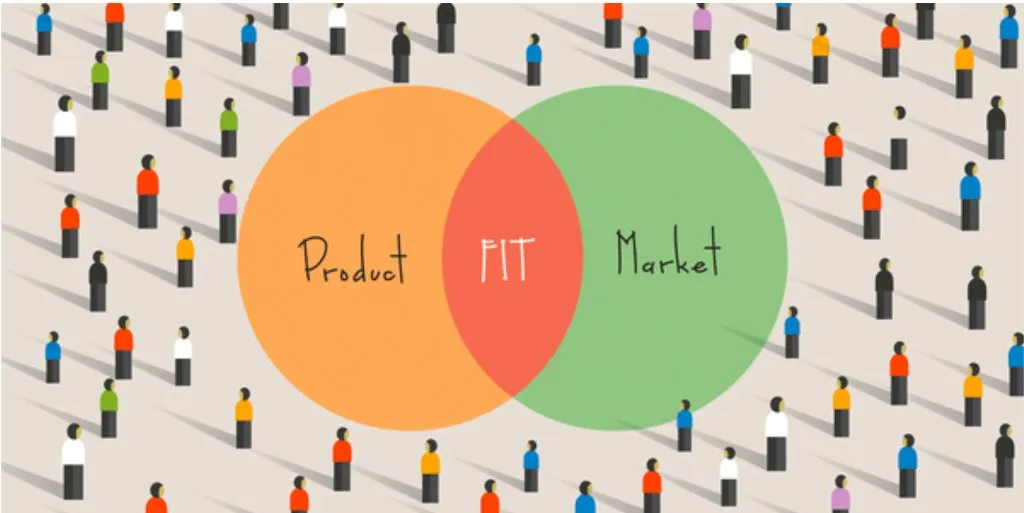
I gave a talk in an entrepreneurship class in 2021 about finding Product Market Fit. Not the theory from a textbook — my actual experience building products at Rocka.co, failing most of the time, and eventually landing on something that worked.
The talk wasn’t meant to be motivational. It was meant to be honest. Building products is hard. Most of them don’t work. The ones that do often take longer than you expect. But if you keep iterating and paying attention to the signals, you eventually learn to recognize when you’re onto something real.
What Product Market Fit Means to Me
For me, Product Market Fit is that moment when the market starts giving you clear signals that there’s a real connection between what you’re building and what people actually need. It’s not something you can measure with a single metric. It’s a feeling — backed by retention, growth, people telling their friends, customers asking for more features instead of asking “what is this?”
I think of it as a Venn diagram: your Product overlaps with the Market and you get Fit. When that overlap is small, you’re pushing a boulder uphill. When it’s big, things start to feel easier. Not easy — but easier.
The hard part is getting there.
How I Learned to Iterate (and Fail)
The only way I’ve found to get closer to PMF is to iterate relentlessly. Build, ship, learn, repeat. Don’t fall in love with your first idea. Test it, watch what happens, and be willing to kill it if it doesn’t work.
At Rocka, we built a lot of products over the years. Some of them I believed in deeply. Most of them went nowhere. Here are a few:
Bootstrup.com
A platform to help entrepreneurs validate ideas and find co-founders. The vision was beautiful — democratize access to entrepreneurship. The reality: getting both sides of a marketplace (idea people + skilled co-founders) to show up at the same time is brutally hard. We had traffic, but no sustained engagement. Lesson: Marketplaces need critical mass on both sides simultaneously. Cold start is everything.
Club Kechef
A cooking subscription box with chef-designed recipes and pre-portioned ingredients. We thought we were solving meal planning fatigue. Turns out logistics (sourcing, packaging, delivery) in Colombia were way harder than we expected. Unit economics never worked. Lesson: Great product idea doesn’t matter if the operations kill you. Know your cost structure before scaling.
Lanzador
A launch platform for digital products. We wanted to be Product Hunt for Latin America. Problem: we didn’t have the community that makes Product Hunt valuable. We built the tool, but we didn’t build the audience first. Lesson: Platforms are only as valuable as their network effects. Build community before features.
Neurocicla
Gamified neurofeedback training for focus and mental performance. Super ambitious. Needed custom hardware, neuro data integrations, clinical validation. We built a prototype, but the path to market was just too long and too expensive for a small team. Lesson: Deep tech is exciting, but beware of products that require years of R&D and regulatory approval unless you have the funding and patience.
Moli Market
E-commerce for local artisans and producers. Inventory management, payments, logistics — we were trying to solve too many problems at once. The product worked, but retention was terrible. Sellers didn’t stick around because getting sales was too hard. Lesson: Don’t build infrastructure unless the core behavior (buyers finding sellers) is already working organically.
KidTrix
Educational games for kids. Parents liked the concept, but we couldn’t crack distribution. App stores are crowded, parents are skeptical, schools move slowly. Good product, wrong go-to-market. Lesson: A great product that nobody discovers is the same as no product.
Bambú Meditación
Meditation app with guided content in Spanish. Calm and Headspace were already dominating. We thought localization would be enough differentiation. It wasn’t. Meditation apps are a winner-take-most market, and we were too late. Lesson: Competing with giants on their turf requires more than a feature (like language). You need a fundamentally different wedge.
Each one of these products taught me something. None of them found PMF. But each failure sharpened my ability to recognize what wasn’t working and why.
The Role of Community
While building all these products, I also got deeply involved in local tech communities: PereiraJS, Pereira Tech Talks, and Python Pereira. These weren’t just side projects — they shaped how I think about building products.
Communities teach you to listen. You hear what people care about, what frustrates them, what they’re willing to pay for. You see patterns. You start to notice when someone’s complaint is a real problem vs. just a one-off gripe.
Running these communities also taught me the value of building in public. Sharing progress, getting feedback early, iterating based on what people actually say instead of what you think they want. That mindset carried directly into how we eventually built DailyBot.
DailyBot: The One That Finally Fit
DailyBot wasn’t born from a grand vision. It was born in an internal Hackathon at Rocka in 2017. The idea: an AI assistant for work automation — specifically, in-chat automation. Automate standups, check-ins, surveys, reminders — all inside Slack and Microsoft Teams, where teams already live.
We built a prototype in a weekend. We used it ourselves. And for the first time in years, I felt the signals I’d been looking for:
People actually used it. Not just once. Every day. Our own team started depending on it. That’s a strong signal.
People shared it. Teammates told friends at other companies. We started getting inbound requests. Organic growth. That almost never happened with the other products.
People asked for more features. Not “what is this?” or “how does it work?” — they understood it immediately and wanted it to do more. That’s the difference between a painkiller and a vitamin.
Retention was strong. Teams that tried DailyBot kept using it. Weekly active usage was high. Churn was low. We weren’t pushing people to stay — they wanted to stay.
We were solving our own problem. This was key. Every other product we built, we were guessing at the problem. With DailyBot, we lived the problem every day. Teams drowning in chat, context switching, repetitive manual tasks. We knew the pain because we felt it.
That’s when I knew we had something.
The Path to Y Combinator
We applied to Y Combinator three times before getting in.
First application (2018): Rejected. The product was too early. We didn’t have enough traction. The pitch wasn’t crisp. We were still figuring out what DailyBot even was.
Second application (2019): Rejected again. This time we had more users, but we hadn’t nailed the go-to-market. YC feedback (inferred from the rejection): not growing fast enough.
Third application (2020): Accepted. By this point, we had real revenue, strong retention, clear positioning (“async work automation for remote teams”), and we could show growth. We also had learned how to tell the story better. The product was the same — our clarity about it had changed.
Getting into YC didn’t validate the product. The market already validated it. YC validated that we were ready to scale.
In 2022, DailyBot was recognized as one of Y Combinator’s Top Companies. That felt like a milestone worth celebrating — not because of the badge, but because it represented years of iteration, learning, and refusing to give up.
What I’d Tell Someone Searching for PMF Today
If you’re building a product and you’re not sure if you have PMF yet, here’s what I’d suggest:
1. Talk to users constantly. Not to pitch. To listen. Ask them what’s hard. Ask them what they’d pay for. Ask them what they tried before your product.
2. Watch retention, not just acquisition. It’s easy to get people to try something once. It’s hard to get them to come back. If retention is weak, you don’t have PMF yet.
3. Solve a problem you have. The products I built for hypothetical users mostly failed. The product I built for myself (and people like me) succeeded. There’s a reason for that.
4. Be willing to kill your darlings. I spent months on products that were never going to work. The faster you recognize a dead end, the faster you can pivot to something better.
5. Iterate faster than you think you should. Don’t wait for perfection. Ship, learn, fix, repeat. Speed of learning is everything.
6. Don’t confuse traction with PMF. You can have users, revenue, even some growth — and still not have PMF. The real test: would your users be upset if your product disappeared tomorrow? If the answer is “meh,” keep iterating.
7. Be patient but not stubborn. Finding PMF takes time. But if something isn’t working after a real effort, don’t cling to it out of ego. Move on.
Final Thoughts
Looking for Product Market Fit is frustrating. You’ll build things nobody wants. You’ll get your hopes up and watch them collapse. You’ll question whether you’re wasting your time.
But if you keep iterating, keep listening, and keep shipping, you’ll start to notice patterns. You’ll get better at recognizing weak signals vs. strong ones. You’ll learn what real demand feels like.
And one day, you’ll build something that sticks. Not because you’re smarter or luckier than before — because you learned from all the things that didn’t work.
That’s what happened with DailyBot. After years of failed experiments, we finally found the fit. And it was worth every failed attempt that came before it.
Let’s keep building.