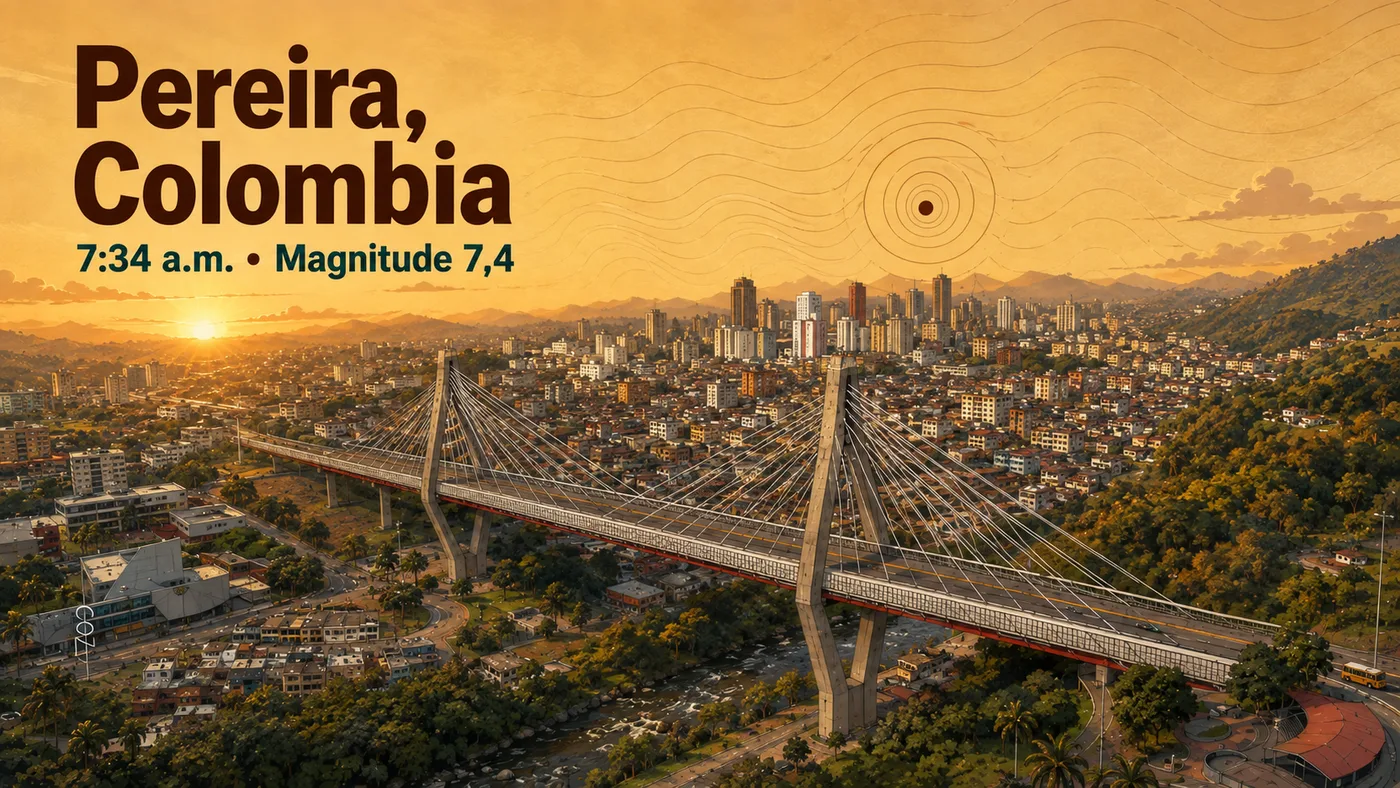
Monday, August 10, 2026. 7:34 a.m.
The Servicio Geológico Colombiano (the SGC, Colombia’s state agency for monitoring seismic activity) recorded a quake in western Colombia that lasted around ninety seconds. We had never felt one that long. The seconds stretched out with no end to them, and all we could do was hope for the best against the helplessness of not being able to do anything about it. Whole buildings came down, houses split open, entire housing complexes ended up on the ground. In some of the videos shot from above you can see, seconds later, all of Pereira wrapped in a cloud of dust, and behind it the chaos.
What followed the chaos was the loss of utilities: power, water, gas, internet. That last one did the most damage. With no signal there was no way to reach anyone, and with no news of your family or your friends, the only option left was to go and check on them, one by one. The whole city walked out into the street at the same time. The roads clogged up, people on foot between the cars, motorcycles on the sidewalk, everyone heading in different directions looking for someone. It looked like the evacuation scenes in zombie movies, except nobody was running away: we were all running toward someone. I had never seen the city like that.
I live in Pereira. And two weeks later I still don’t have a clean way to describe what the city looks like. A lot of Pereira is destroyed, or unrecognizable, and a lot of people need help. That’s not a statistic. It’s the reality we’re living.
What actually happened
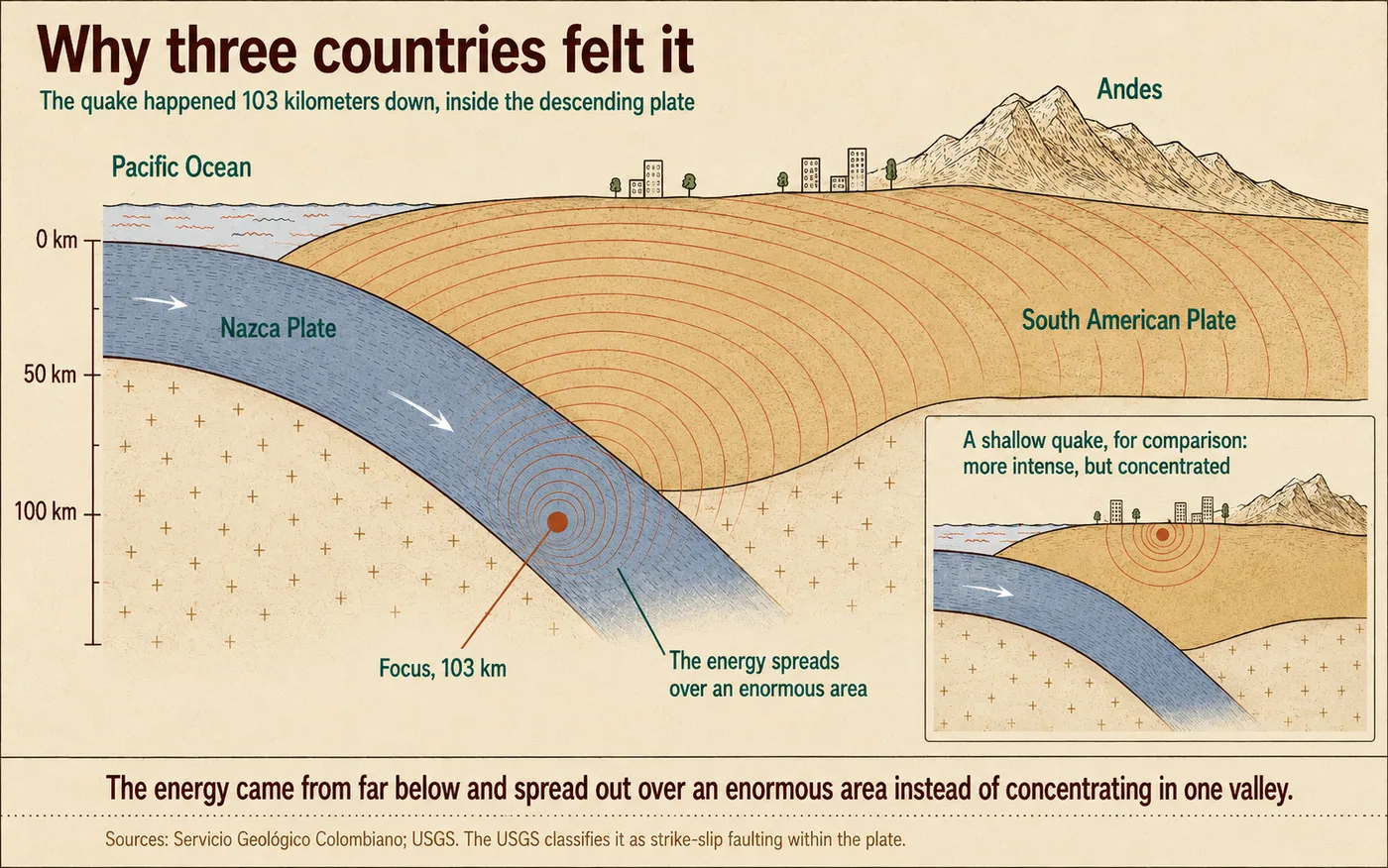
The epicenter was near San José del Palmar, in Chocó, about 20 km from the town. Magnitude 7.4. Depth 103 km according to the SGC, though the USGS puts it slightly deeper, at 110 km.
Those 103 kilometers of depth are why this one didn’t feel like any earthquake we had felt before: it ran for ninety seconds, it was felt in three countries, and the damage came out spread instead of concentrated.
This wasn’t a shallow fault rupturing under a city. Off the Pacific coast, the Nazca plate slides underneath the South American plate. That’s subduction, the same process that built the Andes. This earthquake happened inside that descending slab, more than a hundred kilometers down. The USGS classifies it as strike-slip faulting within the plate rather than a rupture along the plate boundary.
Which means: the energy came from far below and spread out over an enormous area instead of concentrating in one valley. Reports of people feeling it came in from 900 population centers, according to the SGC. It was felt in Panama. It was felt in Venezuela. And it went on and on because, in the SGC’s words, when the magnitude is that high, the energy released can’t fully dissipate before it reaches the surface.
It’s the strongest earthquake recorded in Colombia this century.
Then the aftershocks started. Eighteen by noon on the first day. More than 130 by six in the morning on August 12, ranging from 0.6 to 4.8, clustered around San José del Palmar, El Litoral del San Juan and Sipí. On the 13th it shook hard again in Chocó in the middle of the night.
The aftershocks are why people stopped sleeping easy. And they’re why no damage report stayed useful for long: a house that looked solid on Tuesday morning could crack open that same night. Two weeks later we’re still on alert: there are a lot of damaged buildings still standing, in permanent danger of coming down, that will have to be demolished as soon as possible.
The catastrophe in numbers
I want to be careful here. I’m going to use numbers because it’s the only way to grasp the size of what happened, but every figure in this section is people: someone with a name, a house, a family. It’s also where a lot of writing about disasters quietly goes wrong. So every figure below comes with two things: where it came from (the UNGRD, city governments, the SGC, DANE (the national statistics agency), the press where there is no official count) and the hour it was recorded. In an emergency, a number without a date isn’t data. It’s an old photograph.
A clarification: when I give a figure without naming a city, it’s national. I write from Pereira because it’s where I live, but the earthquake wasn’t local: it shook sixteen departments, and the three cities with the most deaths are in three different ones.
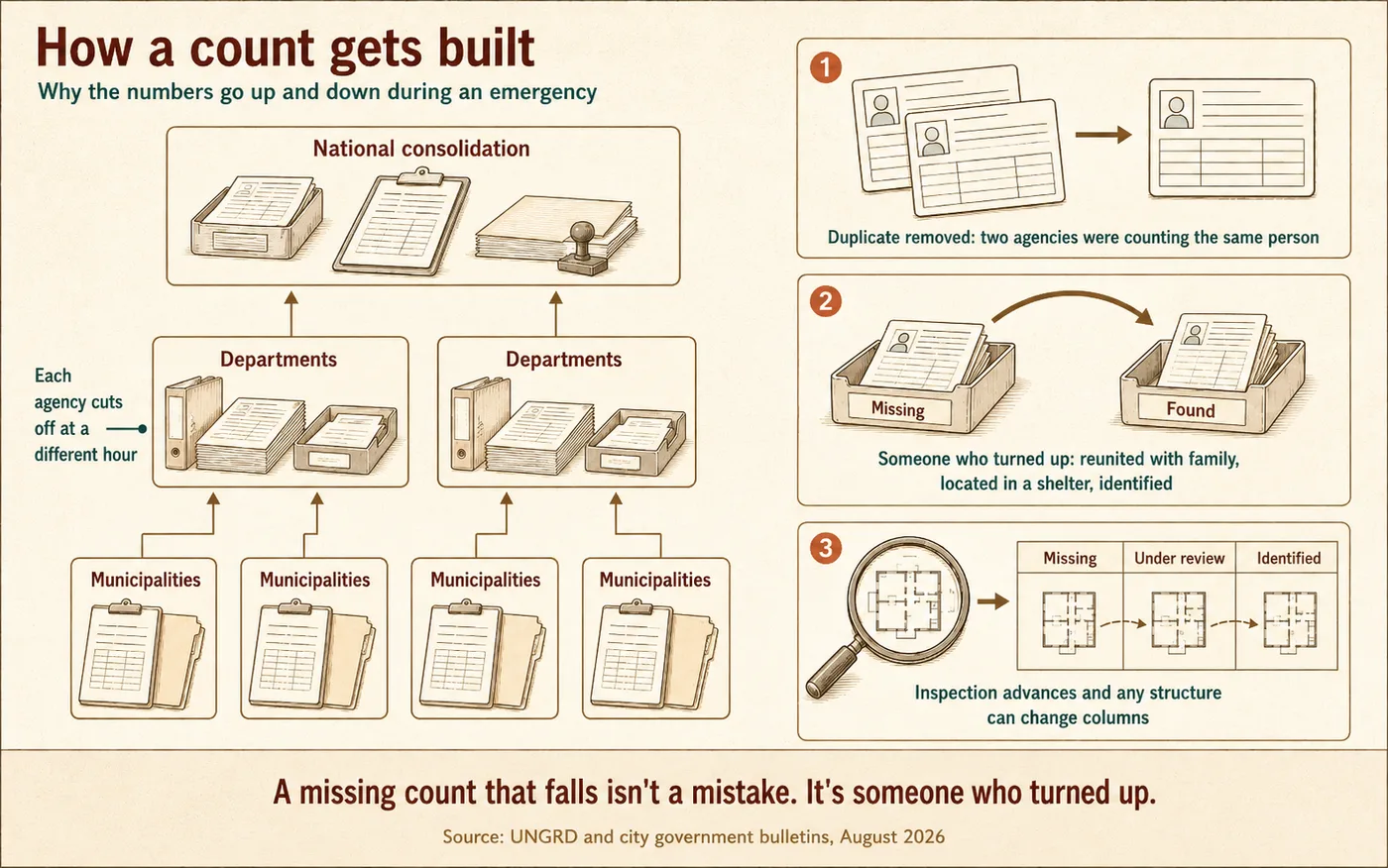
Between August 10 and August 21, the official figures changed every day and sometimes several times a day. The UNGRD (the national agency that coordinates emergency response), Asocapitales (the association of capital cities), individual mayors’ offices and governors published different consolidated counts at the same moment. Not because anyone was lying. Because each one cut off at a different hour, and for the first days there was no single national consolidation.
Here’s the shape of it:
| Recorded | Deaths | Injured | Missing |
|---|---|---|---|
| Aug 10 (preliminary) | 132 | 570 | — |
| Aug 12, 7:30 a.m. | 239 | 3,755 | 287 |
| Aug 13, 5:00 p.m. | 281 | 3,971 | 379 |
| Aug 14, 9:00 a.m. | 288 | 4,018 | 202 |
| Aug 15, 6:30 a.m. | 294 | 3,935 | 320 |
| Aug 16, 6:30 p.m. | 287 | 4,147 | 194 |
| Aug 21, 6:30 a.m. | 321 | 4,595 | 257 |
| Aug 21, 6:30 p.m. (UNGRD) | 329 | 4,600 | 247 |
The last two rows are the same day, twelve hours apart.
It’s the most recent balance published as I write this: 154,014 families, around 314,751 people, spread across 481 municipalities.
The figures fluctuated from one day to the next. The missing: 379 on August 13, 202 the next day, 320 the day after, 194 the day after that. The dead between the 15th and the 16th: 294 to 287, downward. And collapsed buildings, between August 20 and August 21: 302 to 467 and then 553, while damaged ones dropped from 5,809 to 5,726.
None of that is anybody’s mistake. The missing who drop off are people who were found: reunited with family, located in a shelter, identified. The ones who reappear are reports that hadn’t reached the tally yet. A death count that falls is usually a purged duplicate, two agencies counting the same person. And the 251 buildings that showed up collapsed in thirty-six hours didn’t come down in those hours: it’s inspection catching up, and every structure an engineer walks into can change columns. Behind every correction there are human beings cross-referencing lists. I’ll come back to that in this series, because some of that cross-referencing happened in software that didn’t exist the week before.
Deaths by department, at the August 13 cut (the last breakdown the UNGRD published): Valle del Cauca 125, Risaralda 94, Chocó 14, Caldas 6, Quindío 3, Antioquia 1. According to Asocapitales, capital cities accounted for roughly 75% of the dead. This was an urban disaster. Note, though: those six departments add up to 243, and the national consolidation for that same day stood at 281. They don’t reconcile, and I couldn’t find an official explanation for the gap.
And by city. For deaths and missing, the first figure is the Asocapitales consolidation of August 11 and the second is each city’s most recent cut. Collapses and damaged are from the most recent cut:
| City | 👤 Deaths | 👤 Missing | 🏢 Total collapse | 🏢 Damaged | Recorded |
|---|---|---|---|---|---|
| Cali | 95 → 147 | 180 → 47 | 24 | 8,030 | Aug 20 |
| Pereira | 79 → 99 | 37 → 132 | 66 | 35,263 | Aug 19 |
| Quibdó | 9 | 5 | 23 | 862 | Aug 11 |
| Manizales | 5 → 6 | — | n/a | ~10,000 | Aug 20 |
| Armenia | 0 | — | 0 | 14,278 | Aug 20 |
It’s worth pausing on the first row. This article is written from Pereira, but the city with the most fatalities was Cali. As of August 20 the city government reported 147 dead, 1,657 injured and 47 missing, that last figure already cleaned against the lists held by health agencies and families. There were also 24 buildings in total collapse and 33,320 tons of rubble hauled away. Cali has around 2.3 million inhabitants, close to five times the population of Pereira, so the blow was spread across far more people. But no other city came close on deaths.
I record only five cities here because they are the only ones with a comparable starting point: the Asocapitales consolidation of August 11 was the single city-by-city breakdown of the entire emergency, and Asocapitales, as the name says, is the association of capital cities. Without that baseline there is no “before and after” to show. But of the 481 municipalities hit, the other 476 have nobody consolidating them: each city government publishes what it can, when it can, in whatever format occurs to it, and no one assembles the pieces.
And it’s worth stressing that all of these figures have to be taken with a pinch of salt. Every city counts differently. Cali has verified 998 buildings out of 8,030 reports. Armenia counts properties rather than homes. Manizales never separated collapses from structural damage, which is why its cell is empty, and it gives its housing total as an approximation. None of them has finished counting. We are in the early days of an emergency with no final tally yet. These columns size up each city from the inside, not against each other.
Outside the capitals are the municipalities that barely made the news. San José del Palmar, the epicenter. Sipí, Nóvita and El Litoral del San Juan, in Chocó, where the aftershocks clustered. Dosquebradas, right next to Pereira, reported seven dead and more than 250 damaged homes; La Virginia, one dead and around thirty injured. Quimbaya, a town of fifty thousand in Quindío, ended up with 1,000 homes damaged, 450 destroyed and more than 800 families displaced, the highest proportion of housing damage in the whole department.
And Buenaventura was left cut off and without water, its wooden-house downtown flattened. Semana made it out to San José del Palmar and came back with a headline that says a lot about where the cameras were pointed: Quibdó, the capital of Chocó, was in ruins.
Which raises a question that came to me while building the table above: if the epicenter was in Chocó, why is Quibdó the only capital without a cut later than August 11? The department does have figures, the ones I just quoted. Its capital doesn’t. While Cali, Pereira, Manizales and Armenia published their own municipal balances through August 19 and 20, Quibdó never published again. I went looking for it on purpose and it isn’t there. It isn’t that less happened there. It’s that counting is infrastructure too.
Chocó is the poorest department in Colombia. On August 13, three days after the quake, DANE published the 2025 data: 65.3% monetary poverty and 44.3% extreme poverty, the highest in the country. El Espectador’s headline that day said it better than I could: Chocó was already abandoned.
The figures that do exist are enough to show the size of it. By August 13, 29 of the department’s 31 municipalities were reporting damage — 93% of Chocó: 7 health centers, 38 schools and 6 aqueducts came down, and the Hospital Departamental San Francisco de Asís was running with the hospital network at 300% of capacity. That same day the count stood at 21,216 people displaced, 1,144 homes destroyed and 8,868 damaged; the governor’s office would later report 3,128 destroyed and 19,137 damaged. And while that was being counted, Quibdó had no medicine and no medical care, and its neighborhoods held together on community soup kitchens, put together from whatever each neighbor could contribute — a bit of money, or non-perishable food — as one resident described it. The first 36 tons of aid arrived in stages between August 12 and 14.
An earthquake doesn’t land on neutral ground. It lands on what was already there. And the same void that makes aid arrive late makes the data arrive late, or never. When a region is missing from the figures, the explanation is almost never that nothing happened to it.
Armenia stayed standing, and the code explains why
Armenia deserves a special mention: not a single building there collapsed outright. El Tiempo reported it on August 15 and El País confirmed it the next day. What Armenia does have is 80 buildings under evacuation orders for risk of collapse, and zero deaths from fallen buildings. The three deaths Quindío recorded were indirect consequences of the shaking. One woman fell from a balcony in downtown Armenia while the ground was still moving, and died two days later. Another was buried by a landslide on the Montenegro–Quimbaya road, on her motorcycle, on her way to work.
That zero in direct victims stands out above all for where it happened. Armenia is not just any city in this story. On January 25, 1999, a magnitude 6.1 earthquake centered in Córdoba, Quindío, destroyed it. 1,185 people died across the Coffee Region, 921 of them in Armenia. It was the deadliest earthquake in the country’s history. The city was rebuilt essentially from zero.
Twenty-seven years later, a quake that released about ninety times more energy (the magnitude scale is logarithmic, and 1.3 degrees of difference compound like that) left all of Quindío with three.
Chequeado listed the factors that decide how destructive a quake ends up being, and magnitude is only one: the depth of the event, the distance to the epicenter, the type of soil, where soft sediment amplifies the shaking and rock doesn’t, and the vulnerability of the building.
The first three are geography. You inherit them. The fourth is a decision somebody made.
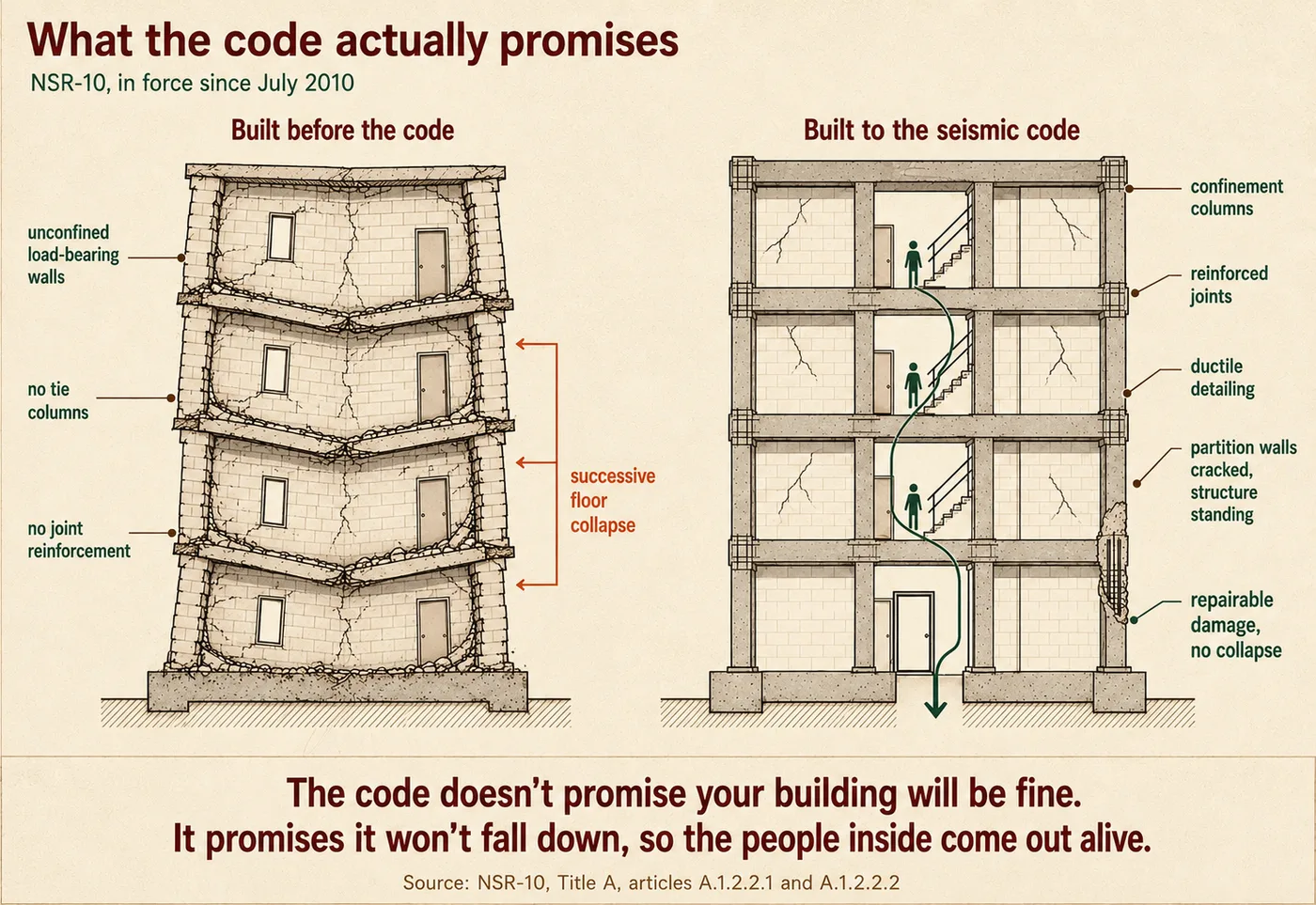
That difference has a name: the seismic building code. Colombia has had a mandatory earthquake-resistant code since 1984, issued in the wake of the 1983 Popayán earthquake. It was updated in 1998, and the version in force today is NSR-10, effective since July 2010. Armenia rebuilt under code, and most of what stands there now went up after 1999.
Here’s the part almost everyone gets wrong, me included until I sat down to read it: NSR-10 doesn’t promise your building will be fine. It promises it won’t fall down. The code says so plainly: a building designed to the Reglamento must withstand “un temblor fuerte con daños a elementos estructurales y no estructurales pero sin colapso” — a strong quake with damage to structural and non-structural elements but without collapse — and after a quake that size the code expects damage that is repairable, while allowing that in some cases repairing it may not be economically feasible. Its stated purpose is to reduce to a minimum the risk of loss of human life. A building can end up cracked, evacuated and ultimately condemned, and still have done its job: it didn’t fall, and the people inside walked out alive. A building left ruined but still standing doesn’t mean the code failed. More often it’s the proof that it worked.
The code is strictest where it matters most: hospitals, schools, universities, fire stations, what the Reglamento calls indispensable and community-service buildings, where it further requires that the damage not be severe enough to inhibit immediate and continued operation and occupancy. Which is why the health figures are the ones that worry me. Hospital Universitario del Valle partially collapsed, and seven major health institutions in Cali were evacuated for structural failure. As of August 20, 348 health centers and 3,483 educational centers had been affected nationwide.
And even so, most construction in Colombia isn’t designed to NSR-10. We have a mandatory code with more than forty years of institutional learning behind it, and a building stock that largely predates it or ignores it.
Which is why Armenia is not luck. It is the cleanest piece of evidence this earthquake produced: where people built to code, they walked out. Federico Núñez, a civil engineering professor at Universidad Javeriana, put it in design terms: “Zero deaths is what the law sets out to guarantee the person living in the building.” It isn’t a lucky break. It’s the code doing exactly what it was asked to do.
And that is the uncomfortable thing about doing the work properly: you almost never get to see it. Nobody films a building that stayed up. Armenia did not make the headlines this time, and that is exactly what makes it the best news in the whole report. Work that holds doesn’t produce images, it produces absences: people who didn’t die, families who didn’t lose their homes, a number that never existed and that nobody will ever count.
But few fatalities doesn’t mean Armenia is fine. Of the 14,278 damaged properties the city has registered, it managed to inspect 2,100 and 354 came back red-tagged, meaning uninhabitable: 235 houses and 119 buildings or complexes, adding up to 2,401 housing units and around 6,427 people. The code saved their lives, not their roofs. The shelter at the Coliseo del Sur reached 56 families, close to its ceiling of 60 and the city is weighing opening a larger one. They are receiving groceries, water, kitchen kits, mats and blankets, and they will need help for months. But because almost nobody died, Armenia dropped out of the news within days. Help tends to arrive where the cameras were.
The bill for that difference was paid twenty-seven years ago. It was paid in boring regulations: technical standards nobody reads for fun, public policy that never won anyone an election, plan reviewers going through blueprints, inspections that somebody at the time surely found to be a nuisance. It was paid by people who were not going to be here when it came due. That is the real reason building codes are so hard to sustain: whoever pays the cost is almost never the one who collects.
But it does come due. Twenty-seven years later, on a Monday at 7:34 in the morning, it came due all at once.
Pereira, my city
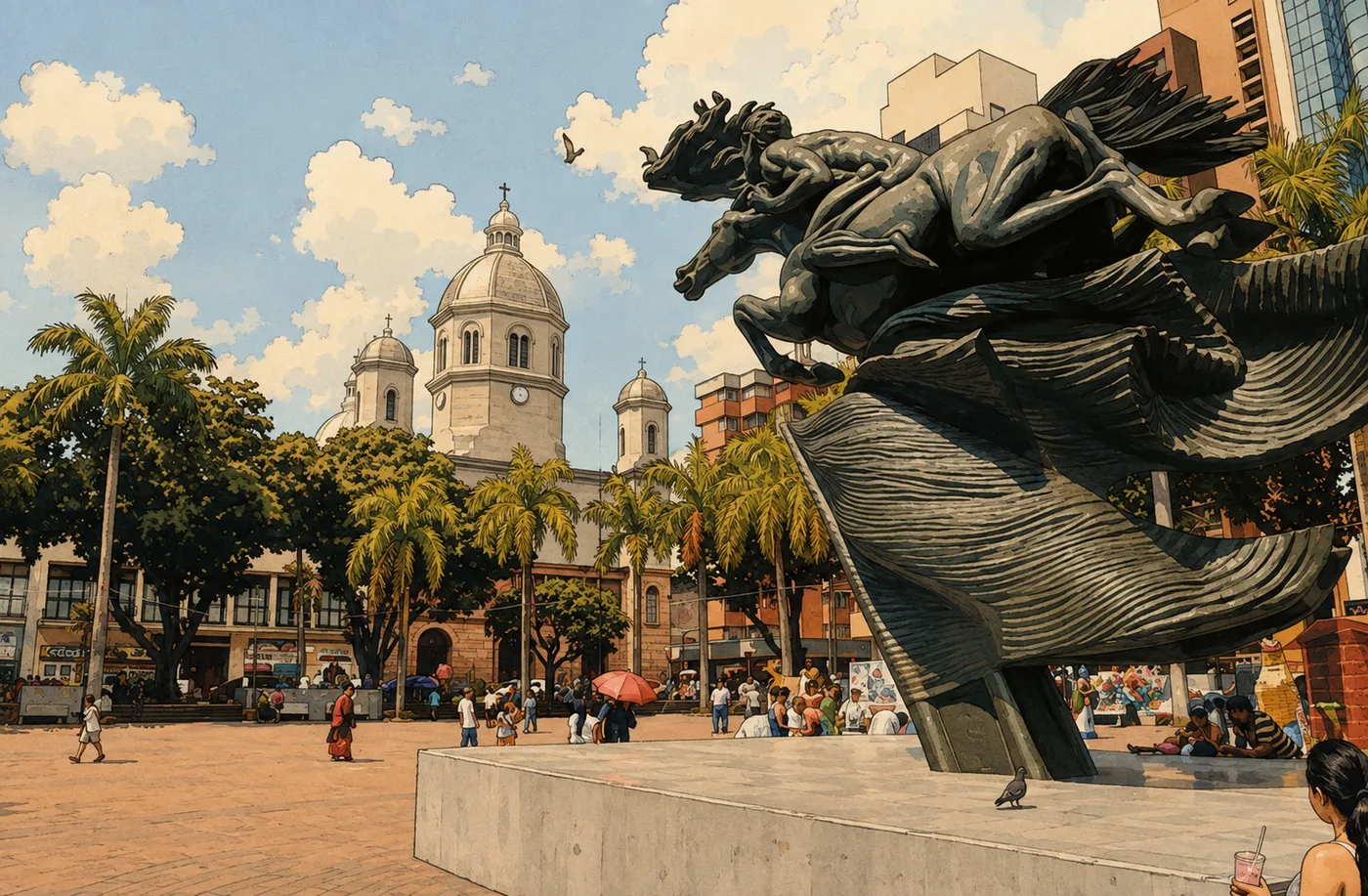
El Tiempo called it the hardest-hit city, and the building count is why.
The city government’s early report: 66 buildings in total collapse, 26 in partial collapse, plus hundreds of damaged homes. Much of that stock predates the seismic code, or went up without applying it, something engineers had been warning about long before the quake. That 66 held in the August 19 structural census, but it wasn’t the only figure going around: John Henry Mora Galvis, president of the Risaralda engineers’ association, estimated some 80 structures fully collapsed when only 10% of the city’s roughly 180,000 properties had been assessed. They don’t contradict each other: one is what’s verified, the other is what’s projected. Mora also warned that the final inventory was going to be considerably larger.
The rest of the balance: 243 people rescued, 279 moved to clinics and hospitals, 14 animals pulled out. By August 19 the Pereira count stood at 99 dead and 132 missing.
The number of buildings destroyed and damaged is staggering, and a few of them stand out. The Invico building on Avenida Circunvalar is one of the ones everyone brings up in disbelief. Its twelfth floor is simply gone. Three people were trapped in it and couldn’t be recovered, because there was no passage left between floors.
That building deserves its own mention, since it left a lot of questions. It was built in the 1970s, which puts it before any Colombian seismic code at all: the first mandatory one arrived in 1984. It had held up through the 1995 and 1999 earthquakes, and even so nobody has explained why this time a single floor came down while the rest stayed up. There is no official cause. A hypothesis is circulating on social media: that walls had been knocked out inside the building during interior remodels. It is officially unconfirmed and will have to be investigated, but it points at something that is true and that a lot of people don’t respect: in a building, not all walls are the same. Some only divide space; others are carrying the building. Taking down one of the second kind without an engineer beside you is pulling a leg out from under the structure.
And there is the other side of everything I said about the code. The code answers for how a building was built. For what gets done to it afterward, the owner answers: modifying a building’s structural system requires a construction permit, and it’s the curadurías and municipal offices that are supposed to demand it. The responsibility exists. What doesn’t exist is any enforcement that can guarantee it’s met, or any way of knowing whether a building handed over up to code is still up to code twenty years later.
The Invico wasn’t the only one. A building next to Pereira’s city hall, part of the emblematic calle del tuvo, came down completely moments after the quake, and, fortunately, the authorities reported no deaths or missing persons in that structure.
I want to mention the Universidad Tecnológica de Pereira separately, because I graduated from there. The Faculty of Environmental Sciences building, one of the most emblematic on campus, was left in ruins, though it is still standing, and sections of roof came down inside the university, injuring students. The UTP moved all academic and administrative activity online and restricted access to the campus while technical teams inspect it building by building: several are damaged, and there is no return date, only a “gradual and scheduled” reopening as the condition of each facility is verified. The university organized its response into four phases, from structural assessment to progressive normalization.
It hurts me to see it like that, and it will be a while before it works in all its splendor again.
And there’s La Lorena, the residential complex that has been talked about most in Pereira. It was 16 five-story towers where about 500 people lived, in one of the city’s most traditional neighborhoods. Today more than 80% of those buildings are at risk: some were reduced to rubble and others were left leaning, and the 16 towers of La Lorena 3 were left in ruins. People died there. Rescue workers could hear some of them calling for help and couldn’t get them out.
What strikes me most is that those buildings had already been through this. They held up in the 1999 earthquake with damage to their façades, and afterward they were structurally reinforced. Even so, twenty-seven years later, they were lost. What’s still standing will have to come down.
My brother lived there and, fortunately, he got out alive. It’s a story that hits close to home for me, and it is only one more inside the count of displaced people who lost their homes in that complex. There are countless stories like it, and this article wouldn’t be long enough to tell them all.
And on August 18, eight days after the earthquake, a three-story house at Calle 26 with Carrera 11 came down on its own. Nobody was hurt: the facade was marked with the city’s risk notice, and the owner had posted a video on the day of the quake warning about the state it was in. That’s why the collapse count kept climbing for weeks. Not everything that fell, fell on Monday.
Shelters opened at Parque El Vergel, Parque El Oso, Coliseo Mayor, Parque Olaya, Plaza de Ferias and Estadio Mora Mora. Two of them hit capacity within days.
Mayor Mauricio Salazar declared public calamity and economic emergency, and imposed a curfew from six in the evening to five in the morning after reports of looting. The building census started on the 12th.
Pereira is in a very hard place, and the rebuilding is measured in years, not months. But the city isn’t alone, and whatever goes back up will go up to code. With the right help, Pereira will come back, and it will come back stronger than it was.
Three days without utilities and without communication
Most of the city lost water, power and internet at the same time, and stayed that way for about three days. Some sectors are still without, or intermittent, as I write this.
Nationally, Andesco, the trade association of Colombia’s utility companies, reported 93% of affected demand restored within days, according to XM, the operator of the national grid. Pereira reached 90%. Some sectors stayed dark on purpose, for safety, not for lack of capacity. Water came back progressively while crews inspected damaged distribution networks. Gas stayed off in several areas while leaks were controlled.
The telecom failure is the one I keep coming back to, and I think it’s the one that did the most damage. With no signal nobody could find out anything about anybody, and that’s what sent the whole city out into the street to look for their families, which only made the chaos worse. But what really weighs on me is something else: the people trapped under the rubble had no way to call for help or say where they were. I believe that with communication, many more lives would have been saved. It was three nights in the dark with no way to reach anyone. According to MinTIC (Colombia’s ministry of information technology and communications), 3,403 mobile base stations went out of service, out of 7,379 across seven departments: 46.1%. In Risaralda the outage reached 77%. Nearly half the cell network in the affected region, gone.
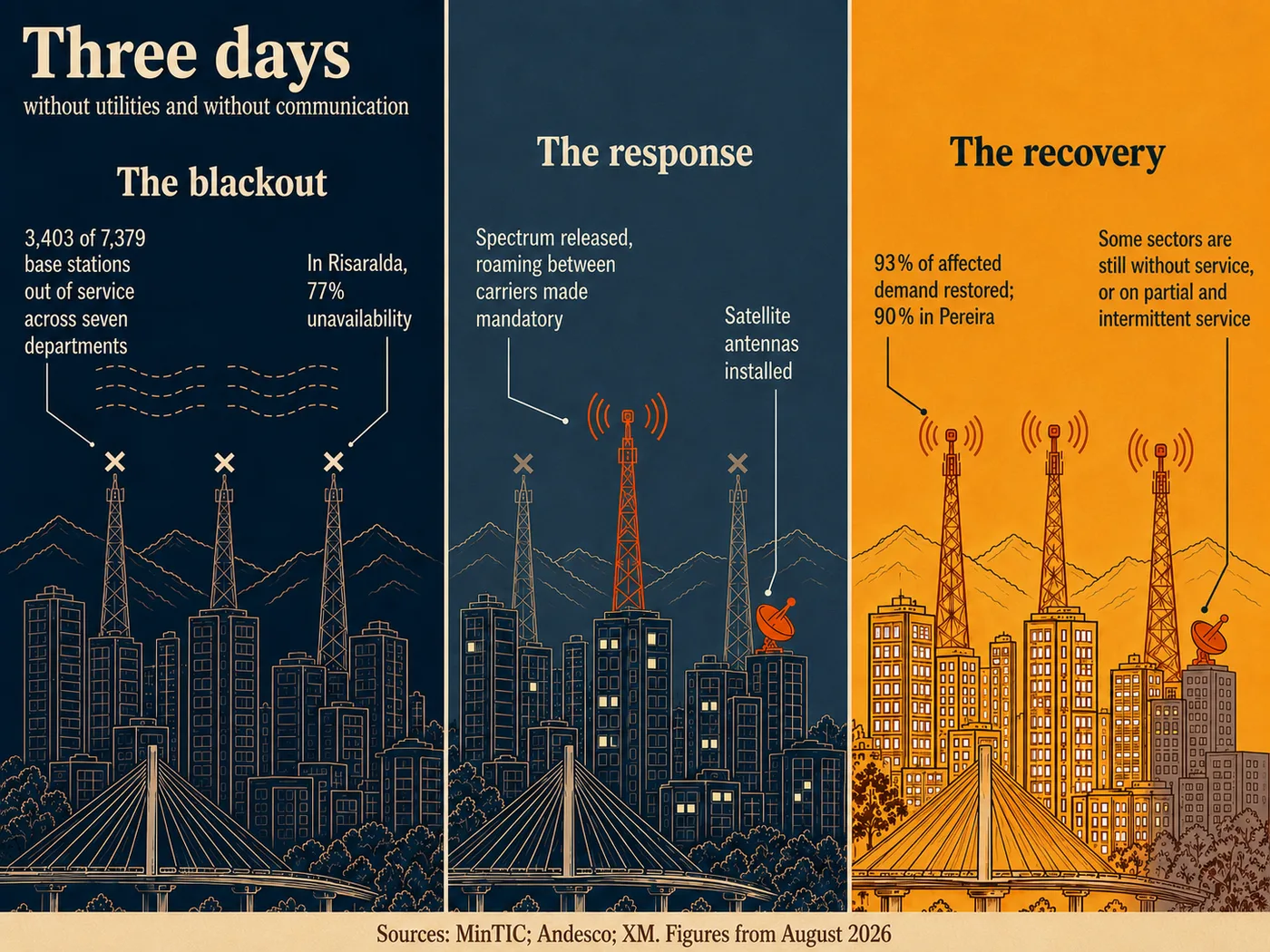
The ministry opened spectrum temporarily, made interconnection between operators mandatory so a call could exit through whichever network was still alive, and made emergency-line calls free for users with no balance. Starlink offered free service until September 12 and shipped equipment for response agencies. Antennas went up in Pereira.
This was important to bring up here because I want to take up, in later chapters of this series, the technology that showed up afterward: the apps, the collaborative maps, the tools people put together within days to search for the missing and coordinate aid. And I don’t want to tell that part without telling this one. For the first days, a large part of the city had no way to load any of it. Everything that got built came later, and it came because the network came back.
The city helped itself
This is the most beautiful part of all of it, and it’s what moves me to write this now.
The collaboration that came out of this has been something else. Doctors worked without stopping. Restaurants cooked. People with trucks moved things. People with a spare room offered it. Students sorted donations in warehouses for entire days. Rescue workers went on far past the point where anyone would have called it reasonable. El Colombiano ran an interview with one of them under the headline “Estoy donde me toque, lo más importante es ayudar” (“I’ll be wherever I’m needed, the important thing is to help”), and in La Patria, a volunteer who had spent days clearing rubble in the La Lorena neighborhood put it this way: “Estamos cansados pero satisfechos de poder ayudar” (“We’re exhausted but glad to be able to help”). Those are their words, not mine.
Everybody contributed from what they knew how to do. And where no trade was needed, a pair of hands was: human chains formed to clear rubble, passing it hand to hand until they could reach whatever was underneath, and to help evacuate buildings nobody knew how much longer would hold. CNN filmed one of those lines, a very long one, moving debris in search of survivors. In La Lorena there were dozens of volunteers calling for silence to listen for anyone still alive down there.
For my part, along with a lot of us who build software for a living, I put to use what I know how to do best: build things that work on the internet. It wasn’t pulling anyone out of the rubble, but it was something the city needed and something we could deliver fast. Within days there were damage maps, supply-center dashboards, missing-person matching tools, platforms where you could ask for help or register the help you were able to give, shelter directories, even a classifieds board for lost pets. Some were built in hours.
I joined Corag and have been helping out ever since. It’s a social movement I came across in the middle of the emergency, though it had existed long before, under a motto that lives up to the name: “Tenemos coraje para servir y transformar vidas” (“We have the courage to serve and transform lives”). They connect people who want to help with the people who need it most, under a rule I think is the right one: every delivery leaves evidence behind. I helped build their landing page, among other things. But there are many more initiatives like it out there, and I’ve been putting together a map of all of them, so the pieces can find each other. That map lives at corag.app/ecosystem.
All of this has brought problems of its own, which I’ll get into in the chapters ahead. The most obvious one is saturation: tools that solve the same thing, competing for the attention of the same people, and not talking to each other. A few days ago those of us behind several of them sat down together to figure out how to stop duplicating each other. Out of that came Cabuya, an open protocol so that applications publish and read the same data without needing anyone’s approval. Each team exposes two files on its own domain, a manifest and a JSON feed of aid locations with no personal data in it, and a public validator measures how well they’re publishing. The idea, in the project’s own words, is for aid to “flow between systems”, under a principle that sums up the moment well: “Crecemos juntos: no competimos, nos alimentamos” — we grow together: we don’t compete, we feed each other.
What the earthquake couldn’t knock down
Pereira has not gone back to normal and it won’t any time soon. The city government is talking about five years of reconstruction and more than ten trillion pesos in damage. There are families waiting for an engineer to tell them whether they can go back into their house, and others who already know they can’t. There are people sleeping badly, getting up when a heavy truck goes by, still feeling the floor move when the floor isn’t moving.
If one thing became clear to me in these two weeks, it’s that people here don’t wait to be told what to do. I saw it in the rescue workers who went far past what anyone would call reasonable, in the doctors who never stopped, in the psychologists who volunteered to sit with families who had just lost everything, in the engineers going building by building so they could tell someone whether they could go home. I saw it in the lines passing rubble hand to hand, in the restaurants cooking for strangers, in the students sorting donations in warehouses for entire days, in the people who drove for hours in a borrowed truck, in the ones who opened up a spare room, in the ones who sat down and coded through the night. This is a region of hard-working people, and that’s the one thing the earthquake couldn’t knock down.
But willingness alone isn’t enough when what lies ahead is many years of hard work. Now comes the second phase, the one that no longer makes the news: inspecting, demolishing, relocating, rebuilding. It will take far more effort than the rescue did and last far longer, and for that Pereira needs real help, from the national government, from institutions, from the whole country. With that help I have no doubt the city will come back. The people who are going to rebuild it have already shown what they’re made of.
Let’s keep building.
Resources
- Servicio Geológico Colombiano — official update on the San José del Palmar earthquake
- Chequeado — questions and answers to understand what happened
- El Tiempo — official UNGRD balance
- USGS — technical page for the event, focal mechanism and fault classification
- El Tiempo — why Armenia had no collapsed structures
- El Tiempo — engineers on the NSR-10: outdated and urgently in need of reform
- Semana — most construction in Colombia isn’t designed to the NSR-10
- NSR-10, Title A — official text of the code (PDF, Spanish): purpose, scope and performance levels
- NSR-10 — what Colombia’s seismic building code is
- El Espectador — Chocó was already abandoned: monetary poverty by department
- El Tiempo — Pereira begins reconstruction: five years and over ten trillion pesos
- UNGRD — official portal of Colombia’s national disaster risk management agency
- Servicio Geológico Colombiano — real-time seismic monitoring portal
- Cabuya — open protocol so aid apps publish and read the same data
- corag.app/ecosystem — directory of the aid apps built after the earthquake
Sergio Alexander Florez Galeano
CTO & Co-founder at DailyBot
Colombian software engineer and entrepreneur (DailyBot, YC S21). I write about AI agents, developer tools, startups, and the craft of software engineering — and I build this site in the open at XergioAleX.com.
Stay in the loop
Get notified when I publish something new. No spam, unsubscribe anytime.
No spam. Unsubscribe anytime.